

Irish tour operators need to contract a licensed Icelandic transfer partner that offers the right fleet size, flight tracking, written safety plans, and clear B2B terms before confirming any Iceland itinerary. Easytransfer is one Iceland-based example built around those exact requirements. Before signing, confirm your partner holds the Icelandic Transport Authority passenger transport permit and, where applicable, Ferðamálastofa licensing.
TL;DR:
- To ensure safety and compliance, verify that Iceland transfer providers hold active permits, insurance, and a written safety plan before booking.
- Summer bookings need at least two to three weeks' lead time, with consideration for peak traffic and vehicle availability in July and August.
- Winter transfers require contingency plans for rapid weather changes and road closures, with extra buffer time for unpredictable delays.
- EasyTransfer offers fixed pricing, flight tracking, and fleet options up to 49 passengers, making it suitable for various group sizes and premium experiences.
- Always confirm provider permits and licenses directly with Icelandic authorities and request operational documentation before finalizing a transfer contract.
Table of Contents
- What Transfer Services Can Tour Operators Book in Iceland?
- What Licenses Must an Iceland Transfer Provider Hold?
- How Should You Choose a Transfer Provider for Group Tours?
- What Should Your Booking Timeline and Contingencies Look Like?
- A Practical Example: What EasyTransfer.is Offers Tour Operators
- How Do Seasons Affect Transfer Availability and Road Conditions?
- Author Perspective: What Irish Operators Get Wrong About Iceland Transfers
- Ready to Book Group Transfers With EasyTransfer.is?
- Where to Verify Permits and Licensing in Iceland
- Sources
- FAQ
What Transfer Services Can Tour Operators Book in Iceland?
Iceland's transfer market splits into a handful of distinct products, and picking the wrong one is the fastest way to blow a group's schedule. A private airport transfer moves one party door-to-door on a fixed timetable, while a shared shuttle transfer consolidates multiple bookings onto a set route with scheduled stops. Coach hire and minibus hire cover the bulk of group work, and super-jeep or highland vehicles handle F-road excursions that standard coaches cannot legally or physically access.
Matching capacity to your group is the real decision point:
- Groups typically fit a single minibus, keeping logistics simple.
- Medium-size groups usually need a coach or a split-transfer plan across multiple vehicles.
- Highland or glacier-adjacent itineraries require 4x4 super-jeeps regardless of group size.
Beyond seating, check for flight tracking, onboard WiFi, luggage capacity per passenger, and wheelchair or child-seat availability. These operational features separate a tourist transportation vendor from a genuine tour operator partner.
What Licenses Must an Iceland Transfer Provider Hold?
Any commercial passenger transport in Iceland requires a permit, and the threshold depends on vehicle size. Vehicles carrying more than nine passengers need a coach or bus permit, while vehicles carrying eight or fewer passengers need an operating permit issued by the Icelandic Transport Authority.
By the numbers: the permit line splits at nine seats. A minibus running at eight passengers falls under the operating permit rules; add one more seat and the coach/bus permit applies instead.
Tour and travel businesses carry a second layer of licensing on top of the vehicle permit. Organized providers need either a Travel Agency License, for package or linked travel arrangements, or a Day Tour Provider License for single-day tours without accommodation. Day-tour providers must also prepare a written safety plan available in both Icelandic and English.
Before you book, request the following from any prospective partner:
- The permit or license number, so you can verify it against the issuing authority.
- Proof of liability insurance covering passenger transport.
- A written safety plan in English, not a summary or a verbal assurance.
- Confirmation of EEA-based operating permits if the provider is a foreign operator running vehicles of eight seats or fewer.
Skipping this step is how agencies end up with an uninsured driver and a canceled group midway through a season.
How Should You Choose a Transfer Provider for Group Tours?
Selection comes down to six criteria, and they should be weighted roughly in this order:
- Legal compliance — valid permits, active license numbers, and insurance you can independently verify.
- Fleet fit — vehicles matched to your group size, including a contingency vehicle for breakdowns.
- Weather and road contingency — a documented process for rerouting or delaying when conditions change.
- Driver experience and language — winter driving credentials and functional English.
- B2B terms — invoicing cycles, net payment terms, and a named account contact.
- Cancellation and refund policy — clear windows and no ambiguity on partial-group cancellations.
When you send an RFP, ask the provider to confirm: vehicle registration and seating capacity, permit numbers, insurance coverage limits, and their written contingency plan for closed roads. A provider that hesitates on any of these is a red flag worth walking away from, along with vague safety plans, no VAKINN listing, and reluctance to put cancellation terms in writing.
Pro Tip: Ask for the contingency plan in writing before you ask for a price. Providers that have one ready usually run tighter operations across the board.
Negotiate a service level agreement that specifies response time for flight delays and a named backup driver or vehicle for peak season.
What Should Your Booking Timeline and Contingencies Look Like?
Quote requests for Icelandic group transfers typically need lead time measured in weeks, not days, especially during peak summer and the Northern Lights season. Lock your fleet choice and passenger manifest at least two to three weeks before travel, and treat any confirmation later than that as a risk to your itinerary.
Every booking confirmation should include details similar to those outlined in a comprehensive airport transfer guide, ensuring smooth logistics and clear communication.
- Full passenger manifest with names matching travel documents.
- Luggage count per passenger, including oversized items like ski equipment.
- Special needs or accessibility requirements flagged in advance.
- Exact pickup and drop-off coordinates, not just hotel names.
Flight monitoring should be automatic on the provider's end, adjusting pickup times against real arrival data rather than the printed schedule. Build buffer time between transfers and activities, since distances and shifting road conditions can turn a short transfer into a much longer one. Before you commit, get the cancellation window in writing. Negotiating a clear cancellation window with full refunds is important to protect your agency when a client group changes plans last minute.
A Practical Example: What EasyTransfer.is Offers Tour Operators
Easytransfer is an Iceland-based private transfer service built around the exact route structure most tour operators need: Keflavík Airport, Reykjavík, Blue Lagoon, and Sky Lagoon. The fleet includes Mercedes vehicles and electric Tesla models, which matters when a client group expects a premium experience rather than a generic coach seat.
What operators should look for, and what to request when sourcing:
- Door-to-door service with fixed pricing and no hidden fees, so quotes hold up against your client budget.
- Flight tracking and instant booking confirmation, reducing the coordination burden on your team.
- 24/7 customer support, useful when a group's flight is delayed at 2 a.m.
- Fleet options up to 49 passengers, covering everything from a small VIP group to a full coach load, plus free onboard WiFi.
- Coverage across the whole of Iceland, so a single partner can handle multi-region itineraries.
When you reach out, ask directly for the safety plan, permit numbers, a sample B2B contract, and proof of insurance. Any established Icelandic private transfers operator should hand these over without friction.
How Do Seasons Affect Transfer Availability and Road Conditions?
Iceland's transfer market moves through two distinct operating modes, and your booking window should reflect that. Summer, roughly May through August, brings long daylight, open highland roads, and the highest volume of group traffic. Vehicle availability tightens fastest in July and August, which means late quote requests risk getting matched with whatever fleet is left rather than the vehicle that actually fits your group.
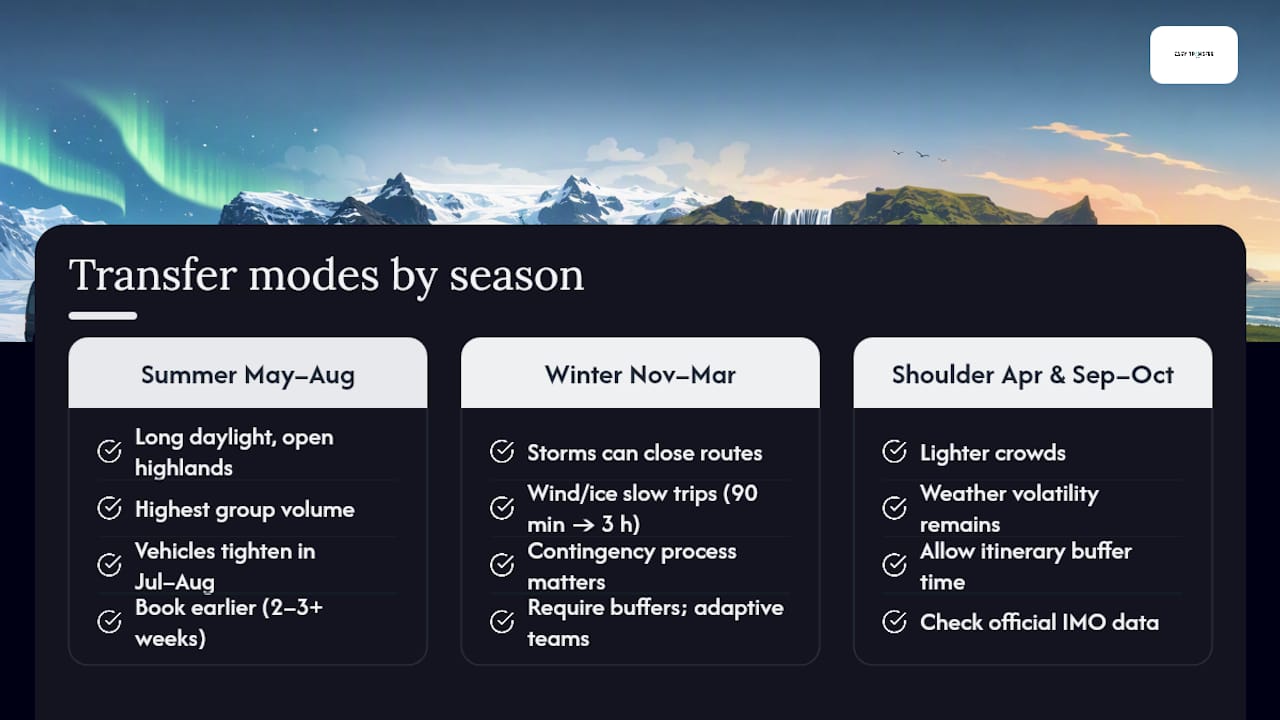
Winter, from November through March, is where road conditions become the deciding factor. Storms can close sections of the Ring Road or the routes toward the Golden Circle with little notice, and a transfer that takes ninety minutes in July can take three hours in February once wind and ice enter the picture. This is exactly why a provider's contingency process matters more than its brochure. Logistics teams that track conditions in real time and adjust routes proactively, rather than pushing a group through unsafe roads to hit a schedule, are the ones worth contracting for winter itineraries.
Shoulder seasons, April and September through October, sit in between: lighter crowds, but still enough weather volatility to warrant buffer time in every itinerary. Whatever season you are booking, check official road and weather data from the Icelandic Meteorological Office yourself rather than relying solely on a provider's word, and build your group schedule with the understanding that Icelandic conditions change faster than most European itineraries account for.
Author Perspective: What Irish Operators Get Wrong About Iceland Transfers
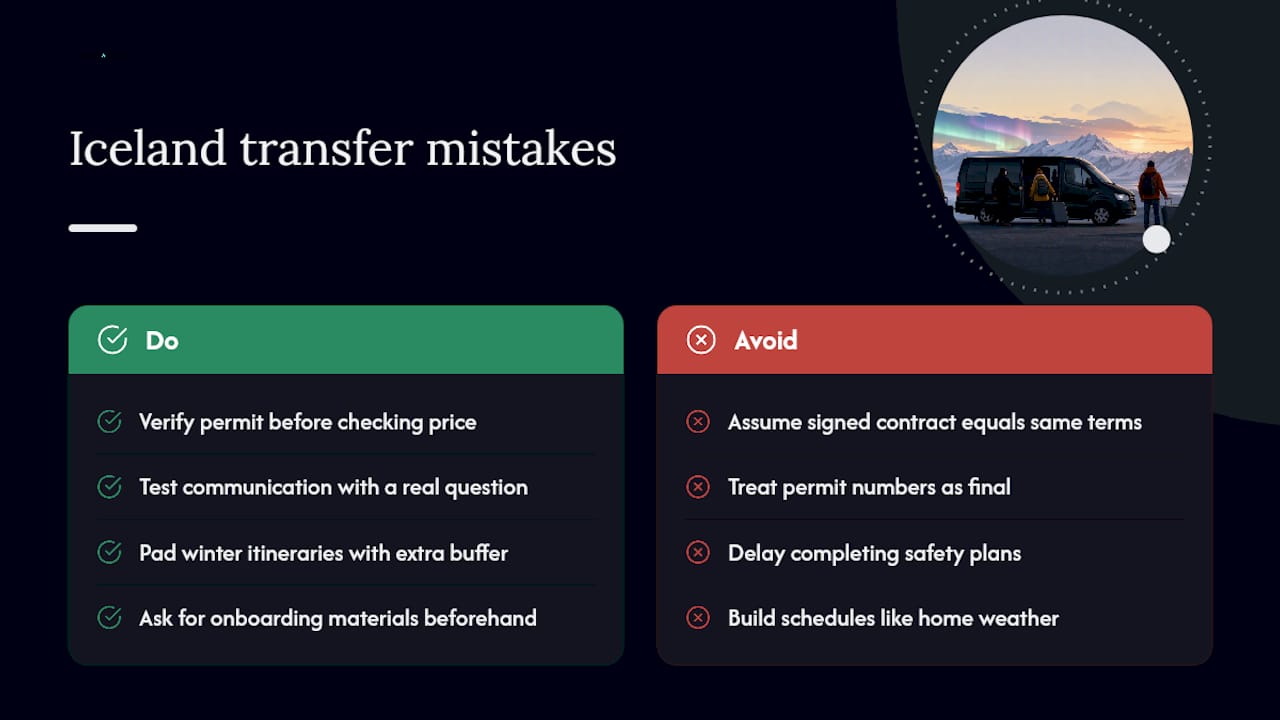
The mistake I see most often isn't picking a bad provider. It's assuming a signed contract means the same thing in Iceland that it means at home. Permit numbers get emailed once and never checked again. Safety plans get requested "eventually." Schedules get built as if February in the highlands behaves like February in Dublin.
Verify the permit before you verify the price. Test the communication workflow with a real question before peak season, not during a flight delay. And pad every winter itinerary with more buffer time than feels necessary. Ask any prospective partner for their onboarding materials before you commit a full season of bookings to them.
— Sergiu
Ready to Book Group Transfers With EasyTransfer.is?
Some private transfer services in Iceland offer features suited to B2B relationships, such as fixed pricing, flight tracking, and fleet options accommodating up to 49 passengers to provide stable quotes.
When you submit a group inquiry, provide your pickup and drop-off locations, expected group size, and travel dates. A sales agent responds within 24 hours with a fixed quote. For recurring partnerships, ask directly about B2B terms, invoicing cycles, and the 24-hour cancellation policy for full refunds. Start your request through the private transfers page, and while you're setting up the partnership, request the safety plan and permit documentation so your agency has it on file before your first group lands.
Where to Verify Permits and Licensing in Iceland
Confirm any provider's credentials directly: the Icelandic Transport Authority for permit status, Ferðamálastofa for travel agency and day-tour licensing, and VAKINN for the tourism quality and safety label.
Sources
- Passenger transport permit | Ísland.is
- Licences & legislation | Ferðamálastofa (Icelandic Tourist Board)
- VAKINN — Icelandic tourism quality and safety certification
FAQ
Which Tour Company Is Best for Iceland?
There's no single "best" operator for every itinerary. The right choice depends on group size, route, and season, but you should prioritize providers with verified permits, a published safety plan, and a fleet that matches your headcount over ones selling purely on price.
What's the Worst Month to Visit Iceland?
February tends to bring the most unpredictable road closures and shortest daylight hours, which makes transfer scheduling harder than in any other month. That doesn't rule out a February trip, but it does mean building extra buffer time into every transfer on your itinerary.
How Much Does It Cost to Fly From Ireland to Iceland?
Flight prices from Ireland to Iceland vary widely by season and booking window, with summer and holiday periods running highest. Check current fares directly with airlines serving the Dublin to Keflavík route, since prices shift too frequently for a fixed figure to stay accurate.
Who Is a Travel Agent That Specializes in Iceland Travel?
Several Irish and Iceland-based agencies focus on Iceland itineraries, and pairing one with a specialized ground transport partner like EasyTransfer.is covers both the planning and the on-the-ground logistics side of a group trip.