

TL;DR:
- The Golden Circle is a leadership framework that emphasizes starting with an organization's purpose to build trust and loyalty. It consists of three layers: Why, How, and What, with Why being the core that influences decisions and culture. Successful application requires authentic purpose, consistent behaviors, and alignment across all organizational levels.
The Golden Circle is defined as a leadership and communication framework, developed by Simon Sinek, that places organizational purpose at the center of every decision and message. Most organizations communicate from the outside in, starting with what they sell, then how they do it, and rarely reaching why they exist. Sinek's model reverses that order. His original 2009 TED Talk has surpassed 65 million views, which signals just how broadly this framework has reshaped thinking about leadership, marketing, and culture. The core claim is direct: people don't buy what you do; they buy why you do it. If you lead an organization, build a brand, or want to communicate more effectively, understanding this model changes how you think about every message you send.
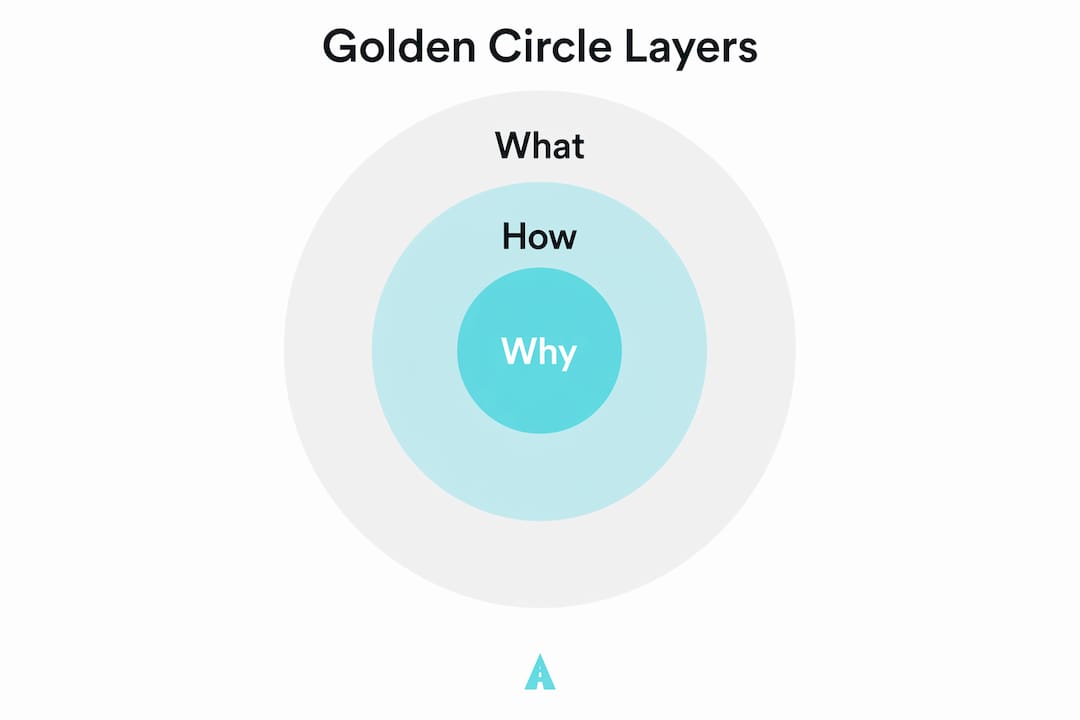
What are the three layers of the golden circle?
The golden circle concept consists of three concentric rings: Why, How, and What. Each ring has a distinct role, and the power of the model comes from moving through them in the right order.
-
Why. This is your purpose, cause, or belief. It is not about profit. Why answers the question: "Why does your organization exist beyond making money?" For a hospital, Why might be "to give every patient the best chance at a full life." For a travel company, it might be "to make every trip feel effortless and worth remembering." Why is the core of the model and the starting point for all communication.
-
How. This ring describes the specific processes, values, and behaviors that bring your Why to life. How is your organization's fingerprint. It includes the standards you hold, the way you hire, and the practices that set you apart. How is where your Why becomes real and repeatable.
-
What. This is the outermost ring. What covers the actual products or services you deliver. Every organization can describe its What easily. The problem is that most stop here and never communicate the deeper layers.
The model works because it mirrors how the human brain processes decisions. The limbic system, which governs emotion and trust, has no capacity for language. It responds to Why and How. The neocortex, which handles rational thought, responds to What. This neurological split explains why a technically superior product can lose to a brand with a stronger sense of purpose. Rational arguments alone rarely build lasting loyalty.
Pro Tip: When you first map your organization's Golden Circle, write each ring on a separate page. Keep Why to one sentence. If it takes a paragraph, you haven't found it yet.

Why is starting with "Why" more effective in leadership?
Starting with Why works because it speaks to the part of the brain that actually drives decisions. Brands that live their Why report stronger employee engagement and cultural alignment than those that lead with product features. That result is not accidental. When people understand and believe in a purpose, they make decisions that reinforce it without being told to.
"People don't buy what you do; they buy why you do it. And what you do simply proves what you believe." — Simon Sinek
The emotional case for Why is strong, but the organizational case is even stronger. Leaders who communicate purpose first create cultures that outlast any single campaign or product launch. Apple and Patek Philippe are two purpose-driven brand examples that consistently link their unique processes back to a deeply held Why. Apple does not lead with processor speeds. Patek Philippe does not lead with watch mechanics. Both lead with belief, and their audiences respond with loyalty that spans decades.
The most common mistake leaders make is treating Why as a marketing slogan. A tagline is not a Why. A mission statement written by a committee is rarely a Why either. Why must be the lens for every strategic decision, from who you hire to which partnerships you accept.
- Why creates cultures that attract people who share the same beliefs.
- How translates that belief into repeatable, observable behavior.
- What gives customers something tangible to point to as proof.
- Skipping Why and leading with What produces transactions, not loyalty.
Pro Tip: Test your Why by asking whether it would change a hiring decision. If your stated purpose doesn't influence who you bring onto your team, it isn't your real Why yet.
How to apply the golden circle model to your organization
Applying the framework starts with finding your authentic Why. This is harder than it sounds. Leaders tend to default to What because it is the most tangible ring, and shifting focus requires deliberate effort. The process below gives you a practical path.
- Unearth your Why. Interview your founders, your longest-serving employees, and your most loyal customers. Ask them why they stay. Look for the pattern in their answers. That pattern is usually your Why.
- Define your How. List the three to five behaviors or standards that show up consistently in your best work. These are not aspirational values. They are things you already do. Your How should be observable and specific.
- Audit your What. Check whether your current products and services actually reflect your Why and How. If a product exists only for revenue and has no connection to your purpose, it creates internal confusion and external skepticism.
- Align leadership communication. Leaders must use Why language in every internal and external message. Town halls, hiring conversations, and client pitches should all start from the same center.
- Use it in workshops. The Golden Circle works well as a strategic planning tool in team workshops. Give each department the same three questions and compare answers. Gaps between departments reveal alignment problems.
Sequential alignment across all three rings is not optional. A strong Why without effective How leads to failure. You can believe deeply in a purpose but still deliver a poor customer experience if your processes don't support that belief. The table below shows how alignment breaks down in practice.
| Ring | Aligned state | Misaligned state |
|---|---|---|
| Why | Clear, authentic purpose that drives decisions | Vague mission statement written for appearances |
| How | Consistent processes and values that reflect Why | Inconsistent behavior that contradicts stated purpose |
| What | Products and services that prove the Why | Offerings driven only by short-term revenue |
What are common challenges and misconceptions about the golden circle?
The most widespread misconception is that Why is a marketing tool. Organizations write a purpose statement, put it on their website, and consider the work done. Treating Why as a slogan rather than a strategic lens produces skepticism from employees and customers alike. Authenticity in Why is not optional. Superficial Why statements reduce engagement rather than build it.
A second challenge is overemphasis on What. Most organizations measure success through product metrics, revenue, and market share. Those are all What-level indicators. They tell you what happened but not why people chose you or whether they will return. Leaders who focus exclusively on What create organizations that compete only on price and features, which is a race with no sustainable finish line.
The framework also has real limits. The Golden Circle is a narrative spine, not a full positioning model. It does not replace market segmentation, competitive analysis, or customer research. Think of it as the foundation you build on, not the entire structure. Organizations that treat it as a complete strategy miss the external work that still needs to happen.
For smaller organizations, the model often works better than it does for large enterprises. SMEs benefit from a founder-driven Why that is direct, personal, and already embedded in the culture. A local business with a genuine reason for existing often outperforms a large corporation with a generic mission statement. The framework's simplicity is an advantage at smaller scale, not a limitation.
Key Takeaways
The Golden Circle works because it aligns organizational purpose with human decision-making, creating loyalty that product features alone cannot build.
| Point | Details |
|---|---|
| Why comes first | Start every strategy, message, and hiring decision from your core purpose. |
| Biology supports the model | The limbic brain responds to Why and How; rational arguments alone rarely build loyalty. |
| Alignment across all three rings | A strong Why fails without consistent How and authentic What to back it up. |
| Not a complete strategy | Use the Golden Circle as a narrative foundation, then layer in market research and positioning. |
| SMEs have a natural advantage | Founder-driven purpose is often more authentic and compelling than corporate mission statements. |
Why the golden circle changed how I think about leadership
I spent years watching organizations build elaborate brand strategies that never stuck. The messaging was polished, the campaigns were expensive, and the results were forgettable. When I first worked through the Golden Circle framework with a leadership team, the shift was immediate and uncomfortable. Nobody could agree on Why. They had plenty of answers for What and reasonable answers for How, but Why produced silence and then argument.
That moment taught me something the framework's critics miss. The Golden Circle is not a communication tool. It is a diagnostic. The difficulty of answering Why reveals exactly where an organization's alignment has broken down. Teams that can answer Why quickly and consistently are already operating from a shared belief. Teams that can't are usually managing symptoms of a deeper problem.
The other thing I've observed is that Why discovery is not a workshop exercise you complete once. It requires ongoing attention, especially as organizations grow and hire people who weren't there at the founding. The leadership and branding connection becomes clearer when you see how quickly a culture drifts when new leaders stop referencing purpose in everyday decisions.
My honest advice: don't start with a mission statement. Start by asking your best people why they stayed. Their answers will tell you more about your real Why than any strategic planning session.
— Sergiu
Easytransfer and the purpose behind every transfer
At Easytransfer, the Why is clear: every traveler deserves a transfer that removes stress from the moment they land. That purpose shapes every process, from flight tracking and fixed pricing to 24/7 support and free WiFi onboard. The How shows up in the details: Mercedes and Tesla vehicles, door-to-door service, and a 24-hour cancellation policy that puts the traveler first.
When you book a private transfer in Iceland, you experience a service built from the inside out. The What, a reliable ride from Keflavík Airport to Reykjavík, the Blue Lagoon, or anywhere across Iceland, is the proof of a purpose that starts long before the vehicle arrives. Easytransfer also works with travel agencies and B2B partners who want their customers handled with the same care. Get a quote, share your pickup and drop-off locations, and a sales agent responds within 24 hours.
FAQ
What is the golden circle?
The Golden Circle is a leadership and communication framework by Simon Sinek built on three concentric rings: Why (purpose), How (process), and What (product). It argues that inspiring organizations communicate from the inside out, starting with Why.
How does the golden circle relate to Simon Sinek's "Start With Why"?
Simon Sinek introduced the Golden Circle in his book Start With Why and his 2009 TED Talk, which has surpassed 65 million views. The framework is the visual model that supports the book's central argument.
Can small businesses use the golden circle model?
SMEs often apply the framework more effectively than large enterprises because founder-driven purpose is direct and authentic. A clear personal Why gives smaller organizations a genuine competitive advantage over generic corporate mission statements.
What is the biggest mistake organizations make with the golden circle?
The most common mistake is treating Why as a marketing slogan rather than a strategic lens. Why must influence hiring, partnerships, and product decisions, not just promotional messaging.
Does the golden circle replace other strategy frameworks?
The Golden Circle is a narrative foundation, not a complete positioning model. It does not replace market segmentation or competitive analysis. Use it to establish internal clarity before building external strategy on top of it.