

Getting your airport transfers right is the difference between a smooth business trip and a stressful scramble. The step by step process for business travel transfers covers six core phases: confirming trip details, choosing the right vehicle, booking through an approved platform, incorporating flight tracking, managing costs and documentation, and applying professional etiquette throughout. Done well, this process protects your schedule, keeps expenses compliant, and reflects well on you and your organization.
Here is a quick overview of what the full process involves:
- Confirm trip details including flight times, passenger count, luggage, and any accessibility needs
- Select the right vehicle type based on group size, budget tier, and the nature of the trip
- Book in advance through a centralized corporate travel platform to stay compliant
- Activate flight tracking so pickup times adjust automatically to delays or early arrivals
- Document all costs with itemized invoices that satisfy IRS and corporate audit requirements
- Apply professional conduct with drivers, clients, and ground staff throughout every transfer
What does the step by step process for booking business travel transfers look like?
The transfer process starts well before you reach the airport. Getting the details right at the planning stage prevents most of the problems that derail corporate ground transportation.
Step 1: Confirm your trip details. Before you book anything, gather the essentials: flight numbers, arrival and departure times, passenger count, luggage volume, and any accessibility requirements. If you are coordinating a group, note whether travelers arrive on different flights within a shared window.
Step 2: Choose your transfer type. Match the vehicle to the trip.
- Private sedan or executive car: Best for solo travelers or pairs, client-facing trips, and early or late flights
- SUV or premium vehicle: Suits small groups of 3–4 or travelers with oversized luggage
- Shuttle or minivan: Cost-effective for groups of 5 or more traveling to a shared destination
- Limousine or prestige vehicle: Reserved for senior executives or high-value client arrivals
- Rideshare or taxi: Acceptable for short, low-stakes transfers when corporate policy permits
Step 3: Book through your corporate platform. Corporate guidelines mandate transfer bookings through centralized platforms that enforce policy compliance by blocking out-of-policy selections at the time of booking rather than catching them in an audit later.
Step 4: Respect advance booking timelines. Individual sedan transfers require at least 24 hours' notice, while group transfers for four or more travelers need 3–7 days to secure the right vehicle and avoid last-minute cost premiums. Large conference groups may need 2–3 weeks.

Step 5: Enable flight tracking. Flight tracking integration allows automatic adjustment of pickup times to accommodate delays or early arrivals, minimizing traveler wait times and preventing provider no-shows.
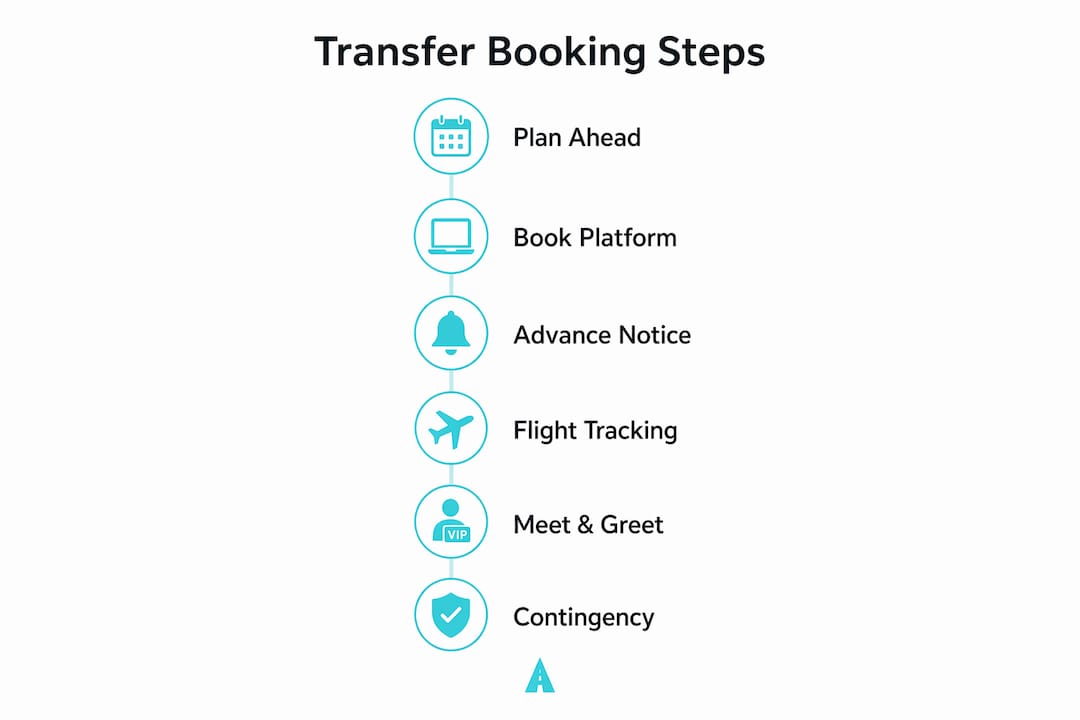
Step 6: Arrange meet-and-greet for executives or clients. For senior travelers and visiting clients, confirm that the driver will hold a name board at the arrivals hall. Standard corporate policies provide 60 minutes of complimentary waiting time for domestic flights and 90–120 minutes for international arrivals.

Step 7: Build in contingency measures. If a driver is more than 15 minutes late, contact the provider hotline immediately. For flight disruptions, use the corporate travel app to update details or send a direct SMS to the driver if their contact was shared in advance.
How do you manage costs and expense reporting for airport transfers?
Cost control on business travel transfers comes down to two things: knowing the rules before you travel and documenting everything correctly after.
The IRS classifies ground transportation expenses for business trips under Schedule C, Line 24a, covering fares between the airport and your hotel, and between your hotel and client or meeting locations. Tolls, tips, and parking fees paid during the trip are also deductible under the same line.
Documentation is where most travelers go wrong. IRS Publication 463 requires final invoices, not booking confirmations or emails. A booking email is a quote; the completed invoice showing actual charges is what auditors want. Your expense documentation must include:
- Date and time of service
- Pickup and drop-off addresses
- Vehicle type
- Base fare with itemized tolls and gratuity
- Total amount charged and payment confirmation
- Business purpose (e.g., "JFK to Midtown client meeting, Acme Corp")
For mixed personal and business trips, you must prorate ground transportation costs. Only the business-use portion is deductible, and you need to document the split at the time of travel, not months later from a credit card statement.
Corporate cost caps typically vary by vehicle tier. Sedans for airport transfers are often approved without a per-trip limit, while SUVs may carry a cap, and group vehicles like Sprinter vans require headcount justification. Transfers outside standard business hours, specifically before 6:00 AM or after 10:00 PM, are pre-approved for safety reasons under most corporate policies, which simplifies both booking and reimbursement.
Pro Tip: Always request a corporate invoice from your transfer provider rather than relying on a credit card receipt. Finance teams prefer invoices because they include all required line items, and submitting a booking email instead of a final invoice is one of the most common audit failures.
Using a corporate account with your transfer provider eliminates the need to submit personal expense reports for every trip. Billing goes directly to the company, the documentation is generated automatically, and you avoid the risk of reimbursement delays. Tracking your travel spending through a centralized system also gives travel managers the data they need to audit compliance and negotiate better vendor rates.
What professional etiquette should you follow during business travel transfers?
How you conduct yourself during a transfer reflects on your organization, especially when a client or executive is in the vehicle with you.
Timeliness comes first. Arrive at your pickup point a few minutes early. For airport pickups, track your flight status so you can alert the driver to any changes before they affect the schedule. Drivers coordinate multiple bookings, and a heads-up call saves everyone time.
Communicate professionally with ground staff. Use clear, polite language with drivers and airport personnel. Avoid phone calls on speakerphone in the vehicle, and keep conversations that involve confidential business information discreet. When transporting a client or senior executive, the transfer environment should feel private and composed.
Professional chauffeur services reduce risk during the "last mile" of business trips by offering verified drivers and digital journey monitoring, which contrasts with the fragmented risk controls of standard rideshare options. This matters for corporate duty of care, which extends beyond flights to every ground movement your company pays for.
Tipping guidance varies by transfer type and time of day. For standard airport transfers, tipping for professional car service is customary and varies with service quality and local norms. For transfers outside normal business hours or in difficult conditions, a higher tip is appropriate and, under most corporate policies, fully reimbursable when itemized on the invoice.
Handling last-minute changes politely and efficiently is part of the job. If your flight is delayed, notify the provider as early as possible rather than waiting until you land. Most professional services monitor flight status automatically, but a direct call confirms the update and avoids any miscommunication. Avoid common travel mistakes like assuming the driver will know about a gate change without being told.
Which tools and platforms help you manage business travel transfers more efficiently?
The right technology turns a complex logistics chain into a manageable workflow. Here is what corporate travel managers and frequent business travelers rely on in 2026:
- Centralized booking platforms like Concur, TravelPerk, or Navan enforce policy rules at the point of booking, flag out-of-policy selections before confirmation, and generate the audit data you need to monitor compliance over time
- Flight tracking APIs integrated with your transfer provider allow real-time pickup adjustments without any manual intervention from the traveler or travel manager
- Mobile apps for driver coordination send the traveler the driver's name, vehicle details, and contact number immediately after booking, reducing confusion at busy airports
- Automated expense reporting tools link each transfer directly to the correct cost center and generate itemized reports that satisfy both corporate finance and IRS documentation requirements
- Meet-and-greet scheduling features within booking platforms let you specify name board requirements, luggage assistance, and arrival hall meeting points in advance
- Data analytics dashboards give travel managers a monthly view of booking compliance rates, out-of-policy selections, and per-trip costs by vehicle tier, which is the foundation for any meaningful spend audit
For group travel coordination, an airport pickup guide helps travel managers handle multiple travelers arriving on different flights under a single booking structure. The goal is to reduce wait times and avoid the cost of booking separate vehicles when a coordinated pickup would cover everyone.
What does the full transfer timeline look like from planning to completion?
A well-run business travel transfer follows a predictable timeline. Knowing each phase in advance keeps you in control, even when flights do not cooperate.
| Phase | Timing | Key Actions |
|---|---|---|
| Initial planning | 1–3 weeks before travel | Confirm flight details, identify group size, select vehicle tier |
| Booking | 24 hours (individual) or 3–7 days (groups) before pickup | Book through corporate platform, confirm meet-and-greet if needed |
| Pre-departure check | 2–4 hours before pickup | Verify driver details, confirm flight status, share updates with provider |
| Pickup window | On arrival | Driver holds name board at arrivals hall; 60 min free wait for domestic, 90–120 min for international |
| Transfer in progress | During ride | Maintain professional conduct, keep confidential conversations private |
| Post-transfer | Within 5 business days | Submit final itemized invoice with business purpose to expense system |
The post-transfer step is where compliance most often breaks down. Expense reports submitted late or with incomplete documentation face rejection or audit scrutiny. Most corporate policies require submission within 14 days of travel, with reimbursements processed within 5 business days after approval. Build the habit of submitting immediately after the trip, while the details are fresh.
For last-minute changes, a fast-track exception process matters. A policy with no clear path for urgent rebooking forces travelers to make unauthorized decisions. The standard that works: one manager, one email, 30 minutes for approval. If the exception process takes longer than that, travelers will bypass it.
How can you make your business travel transfers more sustainable?
Sustainable ground transportation is increasingly part of corporate travel policy, not just a preference. Many organizations now track travel-related emissions as part of broader environmental, social, and governance reporting, and ground transportation is a visible place to make measurable improvements.
The most direct option is choosing electric or hybrid vehicles when booking transfers. Several corporate booking platforms now filter for electric vehicle options, and providers in major US cities increasingly offer Tesla and other EV models as standard fleet choices. When booking through a platform like Concur or TravelPerk, look for a green vehicle filter or ask your travel manager whether the approved vendor list includes EV-equipped providers.
For group travel, a single shuttle or minivan carrying five or more travelers produces far fewer emissions per person than five separate sedans. Beyond the environmental benefit, group transfers also cost less per seat, which aligns sustainability with the cost-cap goals already built into most corporate policies.
Public transit is the lowest-emission option for airport transfers when it is practical. For trips where schedule certainty matters less, routes like the AirTrain at JFK or the BART connection to San Francisco International Airport (SFO) are both cost-effective and low-carbon. When the cost of airport parking is factored in, shuttle or rideshare services are usually the most economical solution for trips lasting three or more days, according to Stanford University's ground transportation guidelines.
Carpooling among colleagues traveling to the same destination reduces both emissions and cost. When several employees arrive on different flights within a 2–4 hour window, a coordinated pickup under a single booking covers everyone without requiring multiple vehicles. This approach is more efficient and directly reduces your organization's per-trip carbon footprint.
Easytransfer makes your Iceland transfers effortless

Planning a business trip to Iceland? Easytransfer handles the ground transportation so you can focus on the work. Every booking includes private transfer options with flight tracking built in, fixed pricing with no hidden fees, and 24/7 customer support. The fleet covers everything from solo executive transfers to group vehicles accommodating up to 49 passengers, with Mercedes models and Tesla EVs available for travelers who want comfort and sustainability in the same booking.
Getting a quote is straightforward. Go to easytransfer.is, enter your preferred pickup and drop-off locations anywhere in Iceland, and a sales agent will respond within 24 hours. Cancellations made more than 24 hours before pickup receive a full refund. For travel agencies and corporate partners, Easytransfer also offers B2B arrangements to handle transfers for your clients directly.
Key Takeaways
A well-executed business travel transfer process covers booking, documentation, professional conduct, and compliance in a single coordinated workflow.
| Point | Details |
|---|---|
| Book with the right lead time | Individual transfers need 24 hours' notice; group transfers require 3–7 days to avoid last-minute premiums. |
| Use final invoices, not booking emails | IRS and corporate auditors require itemized final invoices showing date, route, fare, and business purpose. |
| Enable flight tracking | Real-time flight tracking adjusts pickup times automatically, preventing no-shows and unnecessary wait times. |
| Pre-approved safety transfers | Transfers before 6:00 AM or after 10:00 PM are pre-approved under most corporate policies for safety reasons. |
| Reduce emissions with group bookings | A single shuttle for five or more travelers cuts both per-person cost and carbon footprint compared to individual rides. |