
If your flight ticket says KEF, you're landing at Keflavík International Airport, roughly 50 km from Reykjavík city center. If it says RKV, you're using Reykjavík Airport, a compact domestic hub just 2 km from downtown. Most international travelers fly into KEF. The single most important planning point: if you arrive at KEF and need a domestic flight from RKV, you must collect your checked baggage at KEF, clear customs, and physically transport your bags to RKV yourself before re-checking them.
Here's what to keep in mind from the start:
- KEF (Keflavík International Airport) handles all major international routes, including flights from North America and Europe.
- RKV (Reykjavík Airport) serves domestic Iceland routes and a small number of regional services to Greenland.
- The airports are about 50 km apart. Plan at least 60–90 minutes for any transfer between them, more in winter.
- Baggage is never automatically transferred between KEF and RKV. You handle it yourself.
- Transfer options include Flybus, public bus #55, taxis, rental cars, and private transfers like Easytransfer.
Pro Tip: Check your ticket's airport code before you land. KEF and RKV are not interchangeable, and confusing them can mean a missed domestic connection.
Key Takeaways
KEF handles all international flights roughly 50 km from Reykjavík, while RKV is the domestic city airport 2 km from the center — and transferring between them always means collecting your bags at KEF and transporting them yourself.
| Point | Details |
|---|---|
| Airport roles | KEF is the international hub; RKV handles domestic and limited regional flights. |
| Distance and time | KEF is ~50 km from Reykjavík; allow 45–90 min by bus or 40–60 min by car. |
| Baggage rule | Always collect checked bags at KEF before any transfer to RKV — nothing transfers automatically. |
| Minimum connection time | Allow at least 90 min for bus-based transfers; 60 min for taxi or private car; add time in winter. |
| Easytransfer advantage | Door-to-door fixed-price transfers with flight tracking skip the BSÍ interchange and suit groups and tight schedules. |
Table of Contents
- How do Keflavík and Reykjavík airports compare at a glance?
- Where each airport is located and how long it takes to get there
- Which airlines and flights use KEF vs. RKV?
- Step-by-step: how to transfer between KEF and Reykjavík Airport
- What facilities and passenger services can you expect?
- How to decide which airport to plan around
- Comparing your transfer options between the airports
- Practical checklist before you travel
- What most travelers find easiest, and why
- Easytransfer makes the KEF to RKV transfer straightforward
- Sources
How do Keflavík and Reykjavík airports compare at a glance?
The three differences that affect your trip most:
- Distance makes KEF a genuine logistics challenge for anyone with a tight domestic connection.
- Baggage handling at KEF is your responsibility before any onward domestic leg.
- Facilities at KEF are far more extensive than at RKV, which matters if you have a long layover.
Where each airport is located and how long it takes to get there
Keflavík International Airport sits on the Reykjanes Peninsula, about 50 km southwest of Reykjavík. The site was originally a NATO military airfield, which is why it was built far from the city on flat, open ground. That distance is the defining logistical fact for international travelers.
Reykjavík Airport sits inside the city, roughly 2 km from the main shopping and hotel district. You can reach it by taxi in under 10 minutes from most central hotels.
Travel times from KEF to Reykjavík city center by mode:
- Flybus/coach: 45–90 minutes, depending on traffic and stops; departs from just outside the KEF arrivals hall.
- Public bus #55: Slower and cheaper, with more stops; adds time compared to the direct coach.
- Taxi: Roughly 40–50 minutes in normal conditions; faster but more expensive.
- Private transfer: Similar drive time to a taxi, but door-to-door with no waiting at a bus stop or terminal.
- Rental car: 40–50 minutes; gives flexibility but requires returning the car before flying domestically.
Pro Tip: Icelandic weather changes fast. In winter, add at least 20–30 minutes to any estimated drive time, especially on the Reykjanes Peninsula, where wind and ice can slow traffic significantly.
Which airlines and flights use KEF vs. RKV?
KEF is Iceland's primary international gateway. Icelandair operates most of its transatlantic and European routes through KEF, and virtually every international carrier serving Iceland lands here. If you're flying from the US, Canada, the UK, or mainland Europe, your flight uses KEF.
RKV handles a different kind of traffic entirely:
- Domestic routes: Flights to Akureyri, Ísafjörður, Egilsstaðir, Vestmannaeyjar, and other Icelandic destinations.
- Regional services: A small number of flights to Greenland.
- No scheduled international flights: RKV's runway is too short for wide-body jets, and it is not set up for international border control.
Passport and customs implications matter here. When you arrive internationally at KEF, you clear border control there. Domestic flights at RKV involve no passport checks. That means if you're connecting from an international KEF arrival to a domestic RKV departure, you go through the full customs and immigration process at KEF before you even start your transfer.
Step-by-step: how to transfer between KEF and Reykjavík Airport
This is where most travelers run into trouble. The process is straightforward once you know it, but it has more steps than a typical connecting flight.
- Land at KEF and follow signs to baggage claim. All international arrivals collect bags here.
- Collect all checked luggage. Nothing transfers automatically to RKV.
- Clear customs and exit the arrivals hall. This is your border-control step.
- Choose your transfer mode (see the comparison section below) and head to Reykjavík.
- Arrive at BSÍ bus terminal (if using Flybus or public bus) or directly at RKV (if using a taxi or private transfer).
- Re-check your luggage at RKV for your domestic flight and proceed through the domestic departure process.
Recommended minimum transfer times:
- Flybus to BSÍ, then local transport to RKV: Allow at least 90 minutes from landing.
- Taxi or private transfer direct to RKV: Allow at least 60 minutes from landing.
- Winter travel or heavy luggage: Add 20–30 minutes to either estimate.
Pro Tip: Before you travel, check whether your airline has through-checked your bags. Most do not for KEF-to-RKV connections, but it's worth confirming directly with your carrier. Also screenshot your booking confirmation and the RKV terminal address in case you need to show a driver.
One detail worth knowing: door-to-door private transfers avoid the BSÍ interchange entirely, which typically saves 15–30 minutes on total journey time compared with the Flybus route.
What facilities and passenger services can you expect?
KEF and RKV are built for very different traveler volumes and needs. The gap in amenities is significant.
At KEF:
- Duty-free shopping and multiple retail outlets
- Restaurants, cafés, and fast food options throughout the terminal
- Business lounges (accessible by ticket class or lounge membership)
- Car rental desks from several major agencies, located in the arrivals area
- Luggage lockers and left-luggage services
- Tax-refund counters for non-EU purchases
- Free Wi-Fi throughout the terminal
- Family facilities including nursing rooms and children's areas
At RKV:
- Small café and limited food options
- Basic check-in and boarding facilities
- No duty-free or major retail
- Taxi rank directly outside the terminal
- Free Wi-Fi
- Quick, low-wait domestic boarding process
The facilities difference is most relevant if you have a long layover. At KEF, you can eat, shop, and wait comfortably. At RKV, the experience is functional and fast, which suits domestic travelers perfectly but offers little for anyone with time to fill.
How to decide which airport to plan around
Your itinerary usually makes this decision for you, but here's a quick framework:
- Arriving internationally and continuing domestically? You'll use KEF first, then transfer to RKV. Plan for baggage collection, customs, and a 60–90 minute transfer window.
- Traveling only within Iceland? Book to and from RKV. It's faster, closer to the city, and simpler.
- Short layover in Reykjavík (under 3 hours)? A private transfer is the only realistic option. Bus connections add too much uncertainty.
- Multi-day stopover before a domestic leg? Any transfer mode works. Budget travelers can use Flybus or public bus #55 without stress.
- Group travel or heavy luggage? Pre-booked private transfers remove the hassle of managing bags on a bus. See airport transfer tips for large groups for vehicle sizing guidance.
- Late-night arrivals? Taxis and private transfers run 24/7. Flybus schedules are tied to flight arrivals, so check timings in advance.
The general rule: the tighter your schedule or the larger your group, the more a private transfer earns its cost.
Comparing your transfer options between the airports
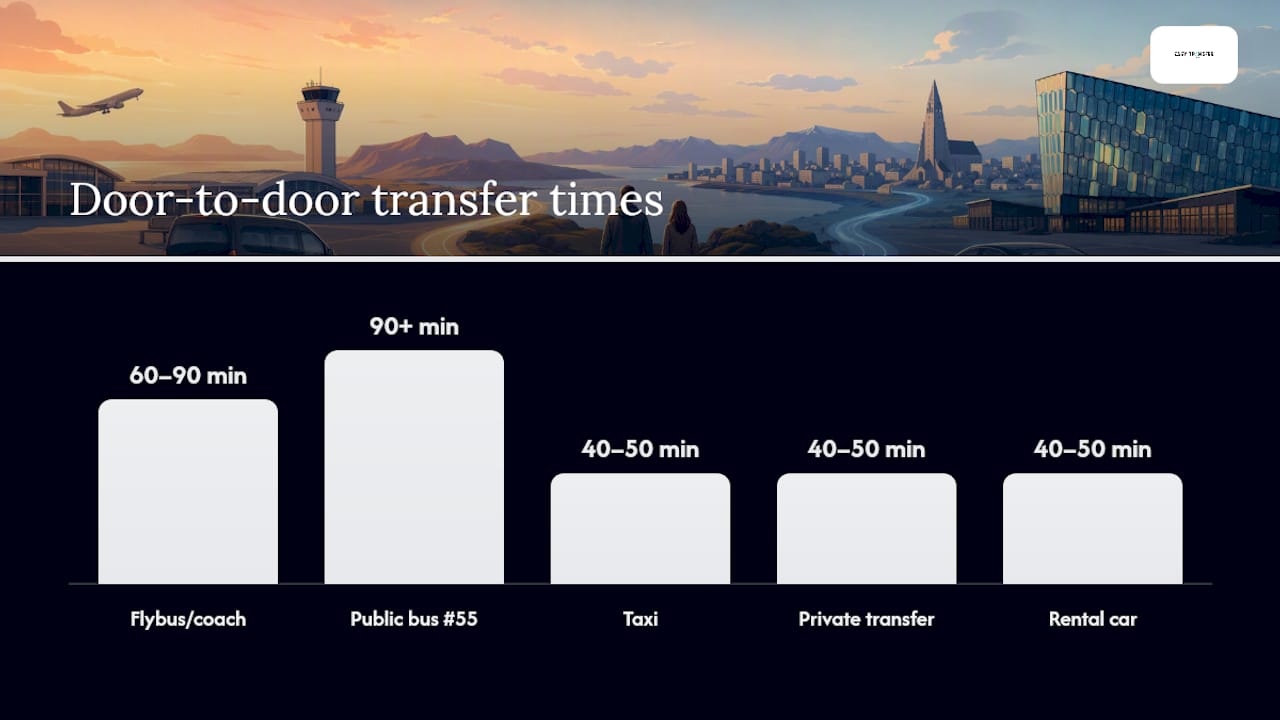
| Transfer Mode | Door-to-Door Time | Cost Range | Luggage-Friendly | Drop-off Point |
|---|---|---|---|---|
| Flybus/coach | 60–90 min | Budget | Moderate | BSÍ bus terminal |
| Public bus #55 | 90+ min | Lowest | Limited | City stops |
| Taxi | 40–50 minutes | Mid-high | Yes | RKV or hotel |
| Private transfer | 40–50 minutes | Mid-high | Yes | RKV or hotel |
| Rental car | 40–50 minutes | Variable | Yes | Self-managed |

A few practical notes on each:
Flybus is the most popular option for solo travelers and couples. It departs from right outside KEF arrivals, runs on a schedule tied to flight arrivals, and drops at BSÍ. From BSÍ, RKV is a short taxi or bus ride away. The trade-off is that BSÍ is not at RKV's door, so you're adding a second leg with luggage.
Public bus #55 connects Keflavík with the Reykjavík area at the lowest price point, but it's slower and stops more frequently. It suits budget travelers with no time pressure.
Taxis are available 24/7 at KEF and offer direct drop-off at RKV or your hotel. Faster than the bus, but the fare is higher and there's no fixed pricing.
Private transfers match taxi speed but add fixed pricing, flight tracking, and vehicle options sized for your group. For families, groups, or anyone with multiple bags, the lack of a BSÍ interchange is a genuine time-saver.
Pro Tip: Easytransfer offers private door-to-door transfers between KEF and RKV with flight tracking and fixed pricing. For groups of four or more, the per-person cost often comes close to Flybus rates, with none of the terminal-to-terminal luggage dragging.
Practical checklist before you travel
Use this before you leave home:
- Verify your airport code. KEF for international, RKV for domestic. Check every leg of your itinerary.
- Confirm baggage policy. Ask your airline whether bags are through-checked. Assume they are not unless confirmed in writing.
- Book your transfer in advance, especially for tight schedules, winter travel, or group trips.
- Allow extra time in winter. Weather on the Reykjanes Peninsula can delay road travel significantly.
- Screenshot or print your booking confirmation and the address of your drop-off point.
- Know where BSÍ is if you're using Flybus. It's Reykjavík's main bus terminal, not at RKV's door.
Pro Tip: If you miss a connection due to a delayed international flight, contact your airline first, then your transfer operator. Easytransfer monitors flight arrivals and adjusts pickup times automatically, which removes one call from your list.
For more on managing bags between airports, this guide on airport transfer luggage tips covers the practical steps clearly.
What most travelers find easiest, and why
Most international arrivals with a domestic connection underestimate the KEF-to-RKV transfer. The steps are manageable, but they stack up: baggage claim, customs, choosing a transport mode, the drive, and then re-checking bags at RKV. Each step takes time, and each one is a point where something can go wrong.
For solo travelers with a generous schedule and light bags, Flybus is a perfectly good choice. It's reliable, affordable, and well-organized. But for anyone arriving with family, a group, or more than one checked bag, the BSÍ interchange adds friction that a private transfer simply avoids.
What I'd tell any traveler planning this route: don't optimize for the cheapest option if your domestic flight departs within three hours of landing at KEF. The cost difference between a Flybus ticket and a private transfer is small compared with the cost of a missed domestic flight and a rebooking fee. Fixed pricing and flight tracking from a service like Easytransfer mean your driver is already adjusting if your international flight runs late.
Easytransfer makes the KEF to RKV transfer straightforward
Choosing a private transfer between Keflavík and Reykjavík Airport means no bus schedules to chase, no BSÍ interchange with heavy bags, and no surprise fare at the end of the ride. Easytransfer provides fixed-price, door-to-door transfers with a premium fleet including Mercedes and Tesla vehicles, capacity for groups up to 49 passengers, and real-time flight tracking so your driver is ready when you land.

The service runs 24/7 with free onboard Wi-Fi and a 24-hour cancellation policy for a full refund. Flybus, taxis, and rental cars are all valid options for the right traveler. But if you're arriving with family, managing multiple bags, or working with a tight connection window, a pre-booked private transfer removes the variables that cause stress. Book your private Iceland transfer and get a confirmed price before you travel.
Sources
These official and authoritative pages let you verify schedules, check terminal maps, and book transfers directly:
- Reykjavík Airport — Wikipedia
- Getting from Keflavík Airport to Reykjavík city centre - Routes North
- Keflavik International Vs Reykjavik Airport: How Do The Facilities Compare? — Simple Flying
- Kefairport