
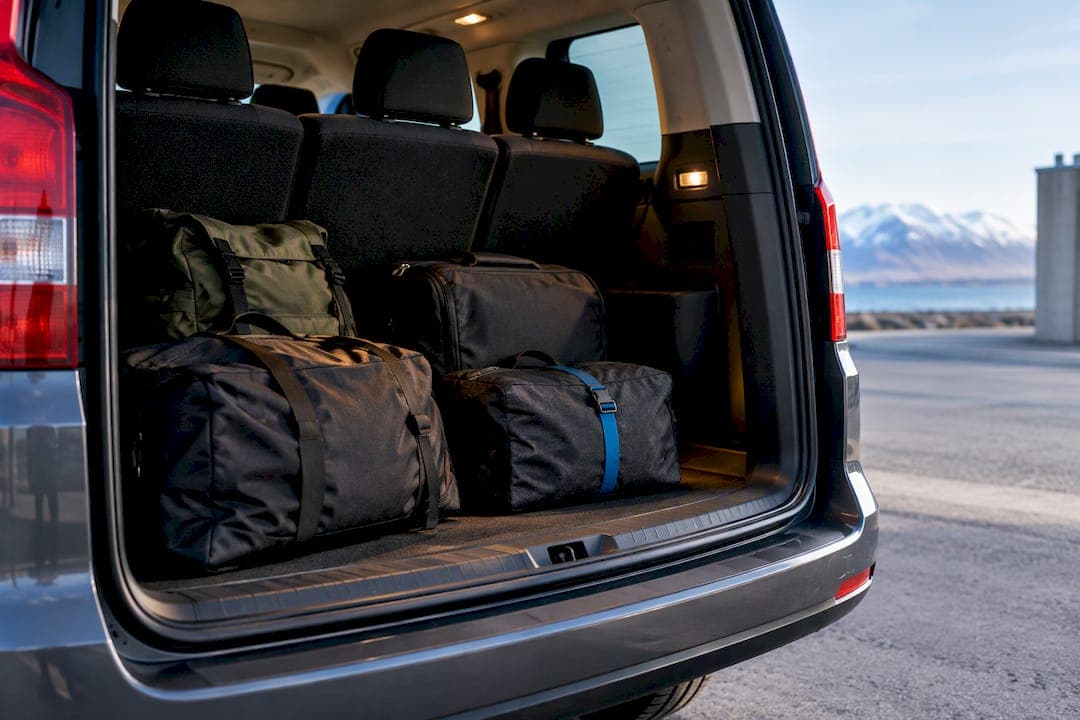
With all seats in use, expect room for roughly one soft bag per person in most 7 to 9 seat rental vans in Iceland. If your group travels with hard suitcases, fold down the rear row, add a roof box, or split into two vehicles. Always confirm the exact model and boot dimensions when you book, since "9 seats" rarely means nine full-size suitcases.
TL;DR:
- Rental vans in Iceland typically offer limited luggage space, with 7-seat models fitting around four large suitcases and 9-seat models suited for soft bags, not full-size hard suitcases.
- Folding or removing the rear seat row can significantly increase cargo capacity, often doubling usable space compared to seats fully in use.
- The "9 seats" label usually includes the driver, meaning actual passenger capacity for luggage is one less; always verify boot dimensions with the rental company beforehand.
- Soft bags are strongly recommended over hard suitcases for maximizing space and protecting luggage on Icelandic roads, especially when packed densely.
- Be aware of road restrictions, especially on Highland F-roads, and confirm the specific vehicle model and capabilities before booking to avoid mismatched expectations.
Table of Contents
- Luggage Space Minivan Iceland: What The Numbers Actually Mean
- Packing Strategies That Maximize Usable Cargo Space
- Choosing the Right Minivan Setup for Your Trip
- Reading the Spec Sheet: What Actually Affects Your Boot Space
- What to Check at Pickup Before You Load the Van
- Road Conditions in Iceland That Change Your Vehicle and Luggage Choices
- When a Private Transfer Beats Renting a Minivan for Heavy Luggage
- Sources
- FAQ
Luggage Space Minivan Iceland: What The Numbers Actually Mean
Rental pages love round numbers. A "7-seat" or "9-seat" minivan listing will often promise a tidy bag count, but that figure only holds true under specific conditions, and those conditions rarely match a group traveling with full seating and full suitcases.
Take the Volkswagen Caddy Maxi, a common 7-seat option on Icelandic rental lots. With all seven seats occupied, Hertz's own vehicle guide lists room for around four large suitcases. Fold the rearmost seats flat, and that number climbs substantially because you've traded two passenger seats for a flat load floor. That trade-off is the single most useful fact in this entire guide: seat count and luggage count move in opposite directions in nearly every minivan class rented in Iceland.
The Volkswagen Caravelle, a step-up in the 9-seat category, follows the same pattern but with a sharper penalty. Hertz's Caravelle spec page warns that with all nine seats in use, rear boot space is "at a premium," and recommends soft bags rather than hard-shell suitcases for full groups. That's not marketing caution. It's a practical warning based on how little room sits behind a third row of seats.
The Toyota Proace Verso tells a similar story from a different angle. Some vendor listings mention capacity for multiple suitcases, though this usually depends on fewer passengers and folded seats. Off to Iceland's own fleet page for the Proace Verso flags limited rear storage when all seats are occupied, which is the honest version of the same claim other listings gloss over.
A few patterns hold across nearly every model you'll find on an Icelandic rental lot, as detailed in the best room types for groups in Iceland, which also provides guidance on group accommodation logistics.
- 7-seat vans with all seats up typically fit 3 to 5 large suitcases, depending on shape and how tightly you pack them.
- 9-seat vans with all seats up typically fit 4 to 9 soft bags, but almost never 9 full-size hard suitcases.
- Folding or removing the rearmost row of seats can roughly double usable cargo volume in either class.
- "9 seats" in vendor copy usually includes the driver, which is easy to miss when you're mentally allocating one seat per traveler and one suitcase per seat.
That last point deserves its own moment. If a listing says "seats 9," your actual passenger capacity for luggage-planning purposes is 8, not 9. Book for 9 travelers thinking you have 9 full seats plus luggage room, and you'll be one bag short before you've left the airport car park.
The most reliable way to cut through inconsistent vendor language is to ask for the actual cubic capacity behind the rearmost seat row, or request a photo of the empty boot with all seats up. Advertised bag counts vary by vendor, by model year, and even by trim level, so treat any number on a booking page as a starting point rather than a guarantee. If a company can't answer a direct question about boot dimensions, that's worth noting before you commit.
Packing Strategies That Maximize Usable Cargo Space
Soft bags win over hard suitcases almost every time you're filling a minivan to capacity. They compress, they squash into odd-shaped gaps around wheel wells and seat frames, and they don't crack when you stack luggage three high for a week-long Ring Road trip. Hertz's own guidance for the Caravelle recommends soft bags specifically for groups using all nine seats, and that advice applies just as well to any 7 or 9 seat van you rent in Iceland.
Here's a loading sequence that consistently gets more into the same space:
- Compress first. Use compression sacks for clothing and soft items before you even get to the vehicle. This alone can shrink a duffel by a third.
- Roll, don't fold. Rolled clothing packs denser than folded stacks and fills irregular gaps better.
- Load the heaviest bags low and centered, near the rear axle rather than piled high against the back window, which keeps the van stable on gravel and wind-exposed stretches.
- Use footwells and under-seat gaps for smaller items like shoes, chargers, and rain gear before you resort to a roof box.
- Fold or remove the rear seat row if your group size allows it. This is usually the single biggest capacity gain available to you, often more than a roof box adds.
- Check roof box weight limits and door clearance before departure, not after you're loaded and parked at a scenic viewpoint.
Pro Tip: Pack one soft duffel per person instead of a hard suitcase whenever your itinerary uses a full 8 or 9 seat layout. You'll fit noticeably more total volume, and soft bags survive being wedged into a half-empty boot corner far better than a rigid case does.
Weight distribution matters for more than comfort. A minivan loaded unevenly toward one side handles worse on Iceland's crosswinds, particularly on the exposed stretches of the South Coast. Spread weight low and centered, and leave sightlines through the rear window clear where your rental contract requires it.

Choosing the Right Minivan Setup for Your Trip
The right vehicle depends on how many seats you actually need versus how many bags you're carrying, and those two numbers are rarely equal. Before you book, work through a short decision checklist:
- Count real passengers, not seat labels. If the listing says "9 seats" and includes the driver, you have 8 usable passenger seats for luggage math.
- Decide if removable seats matter to you. A van with a fully removable third row gives you flexibility a fixed-fold layout doesn't, especially for a Ring Road trip where you're packing and unpacking daily.
- Weigh one big van against two smaller vehicles. For long multi-day trips, Guide to Iceland notes that many groups end up trading a cramped 9-seat van for two smaller cars once everyone's full suitcases are accounted for, and it can work out cheaper than adding a roof box or paying seat-removal fees.
- Match the vehicle to the itinerary, not just the group size. Guide to Iceland's rental-size breakdown stresses that vans are the most spacious class for groups, but that doesn't mean every van suits every route or season.
Ask rental firms these questions directly before you pay a deposit:
- What is the exact model, not just the vehicle class? "Or similar" wording means you might not get the van pictured.
- What are the boot dimensions with all booked seats in place?
- Is a roof rack or roof box available, and what's the weight limit?
- Which roads is this specific vehicle permitted on? Highland F-roads often exclude standard minivans entirely.
Your itinerary changes the calculus too. A single airport transfer needs far less luggage juggling than a 10-day Ring Road loop where you're loading and unloading at every guesthouse. If highland routes are on your list, that's a separate conversation entirely, because most rental minivans simply aren't built or permitted for F-roads.
Reading the Spec Sheet: What Actually Affects Your Boot Space
Rental listings throw a lot of numbers at you, but only a few of them predict how much luggage will actually fit.
The gap between "bags" and cubic volume is the biggest one. A vendor's stated bag count assumes a specific bag size and a specific seating configuration, and neither is always disclosed. Two vans with identical published bag counts can have meaningfully different usable space depending on wheel-well intrusion and how the third row folds.
A few spec details are worth checking line by line:
- Lift-over height, or how high you have to lift a bag to clear the boot lip. Taller vans are harder work for heavy suitcases.
- Whether seats fold flat or simply tip forward. A tipped seat still eats floor space; a flat-folding seat frees it.
- Roof rails and rack compatibility, which determine whether a roof box is even an option for that specific model.
- Tow hitch availability, relevant if a small luggage trailer is on the table for a large group.
"Or similar" phrasing on a booking confirmation means the pictured vehicle isn't guaranteed. Ask for the exact model and, if possible, a current photo of the empty boot before you finalize payment.
What to Check at Pickup Before You Load the Van
The rental desk is your last real chance to catch a mismatch between what you booked and what you're driving away in.
- Confirm the model matches your booking, not just the seat count. "Or similar" substitutions happen, and Saga Car Rental's own minivan listings use that exact wording, which means the van in your confirmation email isn't always the one waiting for you.
- Physically check boot dimensions if you're carrying hard suitcases, rather than trusting the listing photo.
- If you booked a roof box, verify it's attached and undamaged before you leave the lot, not after you've loaded your bags on top of it.
- Clarify "seats" versus "passengers" on the contract. Some agreements count the driver in the total seat number, which affects how many people you can legally carry plus how much luggage room remains.
- Ask whether seat removal is permitted and whether it affects your insurance coverage, particularly if you plan to drive gravel roads with a lighter, less stable load configuration.
- Review your policy's gravel and highland exclusions if a roof box is involved, since wind-loading on an exposed rack can void certain damage waivers.
None of this takes more than a few minutes at the counter, but it's the difference between a smooth pickup and discovering at your first stop that the van you're driving doesn't match the one you paid for.
Road Conditions in Iceland That Change Your Vehicle and Luggage Choices
Iceland's roads dictate vehicle choice more than most travelers expect, and that includes how you're allowed to carry luggage.
Highland F-roads are the clearest example. Vegagerðin, the Icelandic road authority, is explicit that many inland and highland routes are restricted seasonally, and standard rental minivans typically aren't permitted on them regardless of what's strapped to the roof. If your itinerary includes any highland detour, check that specific route's status before you assume your van can handle it.
Gravel roads bring a different set of problems. Loose stone kicked up at speed can chip windshields and damage roof-mounted gear, and a poorly secured roof box adds wind drag that's noticeable on Iceland's often-gusty open stretches. A few precautions go a long way:
- Slow down on gravel sections, both for safety and to protect roof-mounted luggage from vibration damage.
- Double-check roof box latches and straps at every fuel stop on longer driving days.
- Avoid loading a roof box right up to its weight limit if you're also driving through known high-wind corridors like Vík or the Kjölur route approaches.
- Keep an emergency kit and extra layers accessible inside the van, not sealed in a roof box you can't reach quickly.
Vegagerðin recommends checking umferdin.is or trafficinfo.is before departure, and SafeTravel is worth bookmarking alongside it for real-time weather and closure alerts. Both matter more than most rental companies let on, because a closed road doesn't just cost you time. It can force a same-day change to your luggage setup if you suddenly need a different route that your roof box or vehicle class can't handle safely.
Check these resources the night before any day involving mountain passes, the North, or the highlands, not just once at the start of your trip. Conditions in Iceland shift fast enough that a route that was fine on Monday can be closed by Wednesday.
When a Private Transfer Beats Renting a Minivan for Heavy Luggage
Sometimes the smartest move for a group with serious luggage isn't a bigger van. It's skipping the driving altogether.
Some private transfer services run door-to-door transfers across Iceland with fleet options that scale up to 49 passengers, which solves the seat-versus-suitcase math this entire guide has been walking through. If your group is landing at Keflavík with a mountain of hard-shell suitcases, golf bags, or ski gear, a private airport transfer sidesteps the fold-seats-or-buy-a-roof-box dilemma entirely.
Transfers make the most sense in a few specific situations: a single point-to-point trip like KEF to Reykjavík, groups carrying unusually bulky items, or travelers who'd simply rather not navigate gravel roads and variable weather themselves. For attraction visits, options like a Blue Lagoon transfer handle the same logistics without you needing to think about boot dimensions at all.
If you do go this route, tell Easytransfer your exact luggage count and any oversized items when you request a quote. You can also review Easytransfer's private transfer options to compare vehicle types before booking, and check current group-coordination advice in Easytransfer's guide to group airport transportation.
Sources
- Toyota Proace Verso | Off to Iceland — fleet page
- VW Caddy Maxi 7 seats passenger van — Hertz vehicle guide
- Driving safely in Iceland – Vegagerðin
- Best Guide to Rental Car Sizes in Iceland — Guide to Iceland
FAQ
How many suitcases can you fit in a minivan trunk?
It depends entirely on the model and seating configuration, but a 7-seat van with all seats in use typically fits around four large suitcases, while a 9-seat van in the same layout usually fits soft bags better than hard cases due to limited rear boot space. Folding down the rear seat row roughly doubles that capacity in most models.
Do you really need a 4x4 in Iceland?
Not for most standard sightseeing routes, but 4x4 becomes important for highland F-roads and winter driving on unpaved routes. Vegagerðin's guidance notes that many inland roads are seasonally restricted regardless of drivetrain, so check road status before assuming any vehicle, 4x4 included, can make the trip.
Is a minivan bigger than an SUV?
In terms of passenger and luggage volume, most minivans offer more usable interior space than a comparable SUV, which is why Guide to Iceland's rental-size guide lists vans as the most spacious option for groups. SUVs typically hold an edge in ground clearance and highland-road capability instead.
Can you tax a van without an NCT?
This depends on vehicle registration rules in your home country rather than anything specific to Iceland rentals, so it's not directly relevant to booking a rental minivan in Iceland. If you're asking about your own vehicle at home, check with your local motor tax office, since rules vary by vehicle category and use.
What does "9 seats" actually mean when booking a minivan?
Vendor listings for 9-seat vans often include the driver's seat in that count, leaving 8 usable passenger seats. Always clarify whether a listed bag count refers to full-size suitcases or smaller bags, since some vendors count one small bag per person rather than full luggage sets.