

TL;DR:
- Keflavík International Airport is Iceland's largest and busiest, handling over 8 million passengers annually. Its strategic location on the transatlantic route makes it a key connection point for North American and European flights. Travelers should plan transportation from KEF to Reykjavik in advance, especially during peak seasons with increased traffic and long customs lines.
Keflavík International Airport (KEF) is the largest airport in Iceland and the country's primary international gateway, handling 8,159,461 passengers in 2025. That number is remarkable for a nation of fewer than 400,000 people. KEF sits roughly 31 miles from Reykjavik city center, making transport planning a key part of every trip. Whether you are arriving for the first time or catching a connecting flight, understanding how KEF works saves you time and stress.
What makes Keflavík International Airport Iceland's largest and busiest?
KEF earns its title as Iceland's main airport through sheer scale and connectivity. Its runways can accommodate widebody aircraft like the Boeing 747 and Airbus A380, which is unusual for a country this size. The airport operates two terminals with mixed Schengen and non-Schengen processing, allowing it to handle passengers from both European and transatlantic routes under one roof.

Passenger growth at KEF has been consistent over the past decade. The airport crossed the 8 million annual passenger mark in 2025, a figure that reflects both tourism growth and Iceland's role as a transit point between continents. For context, Iceland's entire population fits inside a mid-sized American city, yet its main airport rivals those of countries ten times larger.
Iceland's airport rankings by passenger volume look like this:
| Airport | Code | Primary role | Annual passengers (approx.) |
|---|---|---|---|
| Keflavík International Airport | KEF | International flights | 8.16 million (2025) |
| Reykjavik City Airport | RKV | Domestic and regional | Significantly smaller |
| Akureyri Airport | AEY | Domestic | Regional only |
| Egilsstaðir Airport | EGS | Domestic | Regional only |
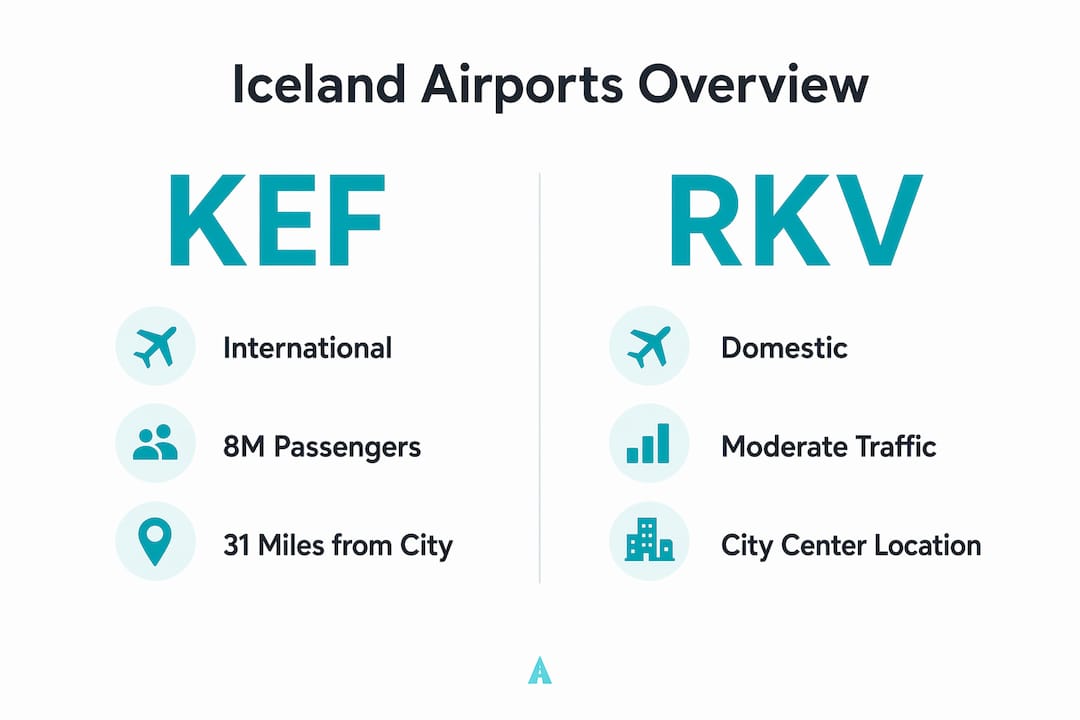
The gap between KEF and every other airport in Iceland is wide. RKV, Akureyri, and Egilsstaðir serve domestic routes and regional traffic. None of them process international arrivals at scale.
Pro Tip: When booking international flights to Iceland, always confirm your ticket shows the airport code KEF, not RKV. The two airports are in different locations, and mixing them up adds an unplanned detour to your trip.
Why does KEF's geographic location matter so much?
KEF sits almost directly on the great-circle route between North America and Europe. That geographic position is not a coincidence of planning. It is the reason Iceland became a transatlantic hub at all.
"KEF's position as a geographic 'accident' provides a unique advantage, making Iceland a key transatlantic transfer point and contributing heavily to its passenger numbers relative to Iceland's population." — BigAirports
Airlines flying between New York and London, or Boston and Amsterdam, pass close enough to Iceland that a stop adds minimal distance. This makes KEF a natural refueling and connection point. Several major carriers use it as a mid-Atlantic hub, which drives flight frequency and keeps ticket prices competitive on transatlantic routes.
KEF also holds a critical role as an ETOPS diversion airport. ETOPS, or Extended-range Twin-engine Operational Performance Standards, requires long-haul twin-engine aircraft to have approved diversion airports within a set flying time. KEF qualifies because of its long runways, 24-hour operations, and full emergency capabilities. This status means the airport must maintain a constant state of readiness, which benefits regular passengers through reliable infrastructure and staffing.
The practical result for travelers is strong flight availability. You can find direct routes to KEF from dozens of North American and European cities, often at lower fares than comparable transatlantic routes that bypass Iceland entirely.
What should travelers know about logistics and amenities at KEF?
Getting from KEF to Reykjavik is the first logistical challenge every international traveler faces. The airport is roughly 40–60 minutes from the city center by road, depending on traffic and weather. Your main transport options are:
- Private transfer: A door-to-door service that picks you up at arrivals and drops you at your hotel. This is the most direct option, especially after a long overnight flight. Easytransfer offers private transfers from KEF with fixed pricing, flight tracking, and vehicles ranging from standard cars to group coaches.
- Shared shuttle bus: Scheduled coaches run between KEF and central Reykjavik. They are affordable but stop at multiple hotels, which adds time to your journey.
- Rental car: Available at the terminal. Useful if you plan to drive around Iceland independently, but requires navigating Icelandic road conditions from the moment you land.
- Taxi: Available outside arrivals. Metered fares apply, and costs can be high for solo travelers.
Inside the terminal, KEF offers a range of amenities. You will find duty-free shopping, multiple dining options, currency exchange, and business lounges. The airport has expanded its retail and food offerings in recent years to match growing passenger numbers.
Peak travel seasons at KEF, particularly summer and the northern lights window from september through march, push the airport close to full capacity. Security lines and passport control can become slow during these periods.
Pro Tip: During peak season, arrive at KEF at least three hours before your international departure. The airport's security and check-in areas can get congested quickly, and Icelandic weather can affect road travel times from the city.
Many travelers search for "Reykjavik airport" when booking and end up with a KEF flight without realizing the airport is outside the city. The KEF airport code is the one to look for on all international bookings. RKV, the city airport, handles domestic routes only and sits inside Reykjavik itself.
How does KEF compare to Reykjavik Airport and other Iceland airports?
The distinction between KEF and RKV is the most important thing to understand before you travel. RKV serves mainly domestic flights and is significantly smaller than KEF. If you are flying in from New York, London, or Copenhagen, your plane lands at KEF. If you are catching a domestic hop to Akureyri or the Westfjords, you likely depart from RKV.
| Feature | KEF (Keflavík) | RKV (Reykjavik City) |
|---|---|---|
| Location | 31 miles from city center | Inside Reykjavik |
| Primary use | International flights | Domestic and regional |
| Passenger volume | 8.16 million (2025) | Much smaller |
| Transfer options | Private, shuttle, rental car | Taxi, city bus |
| Amenities | Full terminal, lounges, dining | Basic facilities |
This distinction affects your transfer planning directly. Travelers connecting from an international flight to a domestic leg often need to move between KEF and RKV. That transfer takes time and requires separate transport. Factoring this into your itinerary prevents missed connections. For a full breakdown of your options, the KEF to Reykjavik transfer guide covers every method in detail.
Other Icelandic airports, including Akureyri (AEY) and Egilsstaðir (EGS), serve regional domestic routes. They are not relevant to international arrivals but matter if you plan to fly domestically after landing at KEF.
What expansions are planned for Keflavík Airport?
KEF is actively expanding to keep pace with passenger growth. Continued expansions include adding gates, taxiways, and a new terminal pier. These projects address the bottlenecks that appear during peak seasons.
The key expansion priorities include:
- New gates: Additional aircraft stands reduce delays caused by gate shortages during busy periods.
- Extended taxiways: Improved ground movement reduces runway wait times and speeds up departures.
- Terminal pier expansion: More space for passenger processing, retail, and lounges inside the terminal.
- Capacity upgrades: Infrastructure improvements aimed at handling continued passenger growth beyond 8 million annually.
These projects reflect a clear trend. Iceland's tourism numbers have grown steadily, and KEF's infrastructure needs to match that pace. The expansions will not eliminate peak-season congestion overnight, but they signal a long-term commitment to improving the traveler experience. If you are traveling in the next one to two years, plan for some construction activity in parts of the terminal.
Key Takeaways
Keflavík International Airport (KEF) is Iceland's largest and only major international airport, handling over 8 million passengers annually and sitting 31 miles from Reykjavik, which makes pre-booked transport a practical necessity for every arriving traveler.
| Point | Details |
|---|---|
| KEF is Iceland's main airport | It handled 8.16 million passengers in 2025, far ahead of any other Icelandic airport. |
| Location requires transport planning | KEF sits 31 miles from Reykjavik, with a 40–60 minute drive depending on conditions. |
| KEF and RKV serve different purposes | KEF handles international flights; RKV handles domestic routes inside the city. |
| Peak seasons cause congestion | Arrive at least three hours early during summer and northern lights season. |
| Expansions are underway | New gates, taxiways, and terminal space are being added to meet growing demand. |
Sergiu's take on navigating KEF without the usual headaches
The single biggest mistake I see travelers make at KEF is underestimating the distance from the city. People land, feel the relief of arrival, and then realize they have no plan for getting 31 miles into Reykjavik. At midnight in january, with Icelandic wind and a full suitcase, that gap feels much larger than it looks on a map.
The second mistake is confusing KEF with RKV. I have spoken with travelers who booked a domestic connection from RKV without realizing they would need to arrange separate transport between two airports in different locations. That is a stressful situation that a quick check of airport codes would have prevented.
My honest recommendation: book your transfer before you land. Not at the airport, not from a shared shuttle queue. Before you land. Easytransfer tracks your flight and adjusts pickup times automatically, so a delayed arrival does not leave you stranded. That kind of reliability matters more in Iceland than in most places, because weather can affect road conditions at any time of year.
The airport itself is well run. KEF maintains consistent operations despite seasonal peaks, and the terminal facilities are genuinely good for an airport this size. The duty-free section is one of the better ones in Northern Europe. But none of that matters if you are stuck at arrivals without a ride.
Plan the transfer first. Everything else at KEF takes care of itself.
— Sergiu
Private transfers from KEF made simple with Easytransfer
Arriving at Keflavík Airport after a long transatlantic flight is tiring enough without worrying about transport. Easytransfer takes that worry off your plate with door-to-door private transfers from KEF to Reykjavik, the Blue Lagoon, Sky Lagoon, and destinations across Iceland.

Every booking includes flight tracking, fixed pricing with no hidden fees, and 24/7 customer support. Vehicles range from standard cars to coaches that seat up to 49 passengers, so the service works for solo travelers and large groups alike. You can also add a Blue Lagoon transfer directly from the airport if you want to start your Iceland trip with a soak before checking in. Cancellations are free up to 24 hours before pickup. Book online and get instant confirmation.
FAQ
What is the largest airport in Iceland?
Keflavík International Airport (KEF) is Iceland's largest airport. It handled 8,159,461 passengers in 2025 and serves as the country's primary international gateway.
How far is Keflavík Airport from Reykjavik?
KEF is approximately 31 miles (50 km) from Reykjavik city center. The drive takes 40–60 minutes depending on traffic and weather conditions.
What is the difference between KEF and RKV?
KEF handles international flights and is located outside the city. RKV (Reykjavik City Airport) serves domestic and regional routes and sits inside Reykjavik itself.
How many airports does Iceland have?
Iceland has several airports, including KEF, RKV, Akureyri (AEY), and Egilsstaðir (EGS). KEF is the only one handling significant international traffic.
When should I arrive early at Keflavík Airport?
During summer and the northern lights season, KEF operates near full capacity. Arriving at least three hours before your international departure is the safest approach during these peak periods.