
TL;DR:
- Icelandic names are based on a patronymic and matronymic system where each generation creates a new last name from a parent's first name. The country's naming regulations require names to be approved or registered, ensuring they conform to Icelandic grammar and language rules. In daily life, Icelanders address each other by first name, making personal connections and reflecting their unique naming traditions.
Icelandic names are defined by a patronymic and matronymic system in which a person's last name derives directly from a parent's first name, not from a shared family surname. This makes Iceland one of the few countries in the world where siblings can legally carry different last names. The Icelandic Naming Committee, known as Mannanafnanefnd, governs which given names are permitted, and the official Icelandic Personal Name Register determines whether a name is valid without committee review. Whether you are researching Icelandic baby names for a new arrival, tracing ancestry, or simply fascinated by Old Norse linguistics, this guide covers the full picture: how the system works, what the rules are, which names topped the charts in 2025, and what these names actually mean.
How Icelandic names work: patronymics, matronymics, and the gender-neutral suffix
Icelandic last names are not inherited. They are constructed fresh for each child based on a parent's first name. The mechanics follow a clear formula, and once you understand it, the entire system clicks into place.
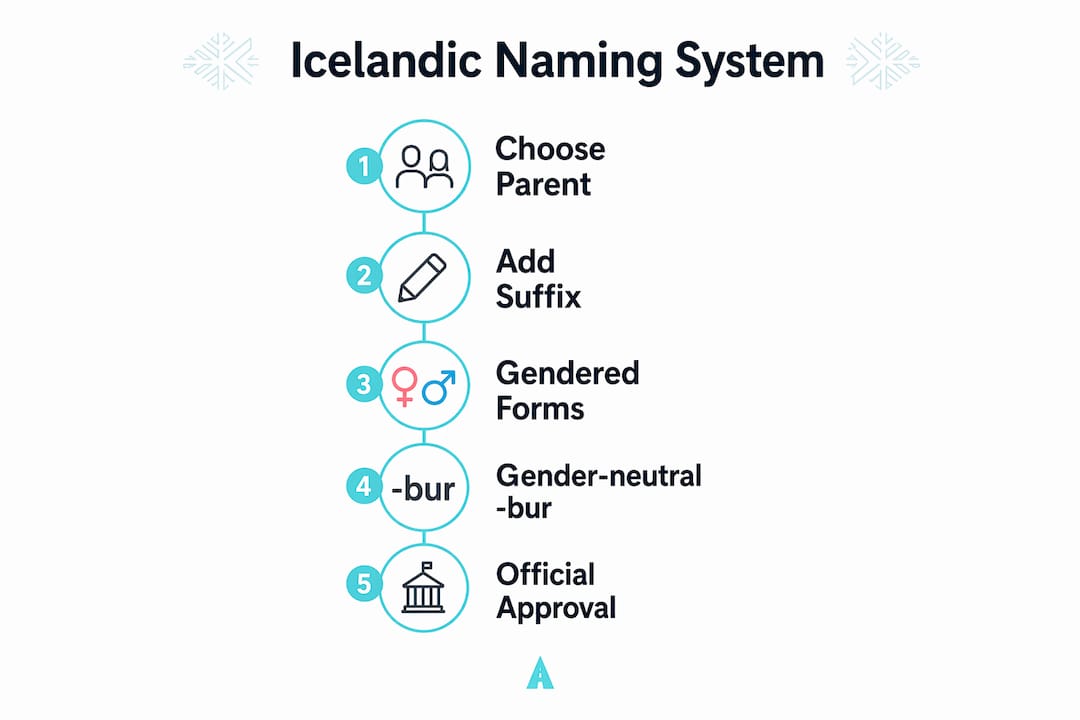
Icelandic children's last names are formed by taking the genitive form of a parent's first name and adding one of three suffixes:
- -son (meaning "son of") for male children
- -dóttir (meaning "daughter of") for female children
- -bur (meaning "child of") for gender-neutral identification, introduced in 2019
Here is how this plays out in practice. If a father's name is Jón, his son becomes Jónsson and his daughter becomes Jónsdóttir. If the parents choose to use the mother's name instead, the child of a woman named Anna becomes Annasson or Annadóttir. Iceland also allows compound surnames that combine both parents' names, giving families more flexibility in how they express lineage.
The gender-neutral suffix -bur was introduced in 2019, making Iceland one of the first countries to formally encode a non-binary naming option into law. The suffix literally translates to "child" in Icelandic. A child of Jón who uses this option would carry the last name Jónbur.
One detail that trips up many newcomers: the given first name and the patronymic suffix are two separate things. Name eligibility depends almost entirely on whether the given first name is approved, not on the suffix itself, since the suffix is formulaic and automatic.
Pro Tip: If you are building a family tree for Icelandic ancestors, never assume two people with the same last name are siblings or cousins. The shared suffix just means they had parents with the same first name.
What are the rules for Icelandic name approval?
Iceland's naming regulations are among the most structured in the world. Names must be in the official Icelandic Personal Name Register or receive direct approval from the Icelandic Naming Committee to be considered legally valid.
The committee evaluates names against several criteria:
- The name must be writable using the Icelandic alphabet, which includes letters like ð, þ, and æ that do not appear in English.
- The name must be grammatically compatible with Icelandic declension rules, meaning it must work across all six grammatical cases.
- The name must not cause the bearer potential embarrassment or harm.
- The name must align with Icelandic gender norms, though modern rules have introduced more flexibility for gender-neutral options.
Recent rule relaxations have made the process somewhat more open. Most applications to the Naming Committee are approved; rejections happen mainly when a name fails linguistic fit or uses spelling that conflicts with Icelandic grammar. Foreign names can now be accepted if they are written in an Icelandic-appropriate form. For example, a name like "Charlotte" might be adapted to "Sjarlotta" to satisfy spelling and phonetic requirements.
"Naming is constrained by Icelandic grammar and spelling, so even culturally meaningful names can be rejected if they don't fit linguistic rules." — Morgunblaðið, 2025
This is not bureaucratic overreach. It is a deliberate effort to protect the Icelandic language, which has fewer than 400,000 native speakers globally. The committee's role is as much about linguistic preservation as it is about name administration.
Popular Icelandic names and their meanings in 2025
Iceland's naming trends reveal a culture that balances tradition with quiet creativity. In 2025, 4,439 babies were born in Iceland, with Matthildur topping the girls' list and Birnir leading for boys. These are not random choices. Both names carry deep Old Norse roots.
Many Icelandic names have Old Norse origins with meanings tied to nature, mythology, and personal virtues. Björn means "bear," Freyja refers to "lady" or "noble woman" and connects directly to the Norse goddess of love and fertility, and Sól means "sun." These meanings function as cultural interpretations rather than direct dictionary translations, reflecting centuries of linguistic evolution.
In 2025, 76% of Icelanders were given a middle or second given name, with Máni (meaning "moon") being the most popular second name for boys and Rós (meaning "rose") for girls. This statistic shows that Icelanders are increasingly layering names to add personal or poetic meaning.
| Name | Gender | Meaning / Origin |
|---|---|---|
| Matthildur | Girl | Strength in battle (Old Norse: "maðr" + "hildr") |
| Birnir | Boy | Bear warrior (Old Norse: "björn" + warrior suffix) |
| Freyja | Girl | Lady, noble woman; Norse goddess |
| Björn | Boy | Bear (Old Norse) |
| Guðrún | Girl | Divine rune or secret lore (Old Norse) |
| Jón | Boy | Icelandic form of John; God is gracious |
| Sól | Girl | Sun (Old Norse) |
| Máni | Boy | Moon (Old Norse) |
| Rós | Girl | Rose (borrowed, Icelandicized) |
| Sigurður | Boy | Victory and guardian (Old Norse: "sigr" + "varðr") |
Jón and Guðrún remain the most common names among all living Icelanders, reflecting the enduring pull of traditional names even as newer choices like Matthildur and Birnir gain ground among young parents.
Pro Tip: When researching iceland name origin for genealogy purposes, cross-reference the name's spelling with its Old Norse root rather than its modern Icelandic form. Spelling shifted significantly between the Viking Age and the 20th century.
How Icelandic names shape everyday social life
The patronymic system does more than change how last names are formed. It reshapes how Icelanders relate to each other in daily life, and the effects are visible in everything from phone books to presidential addresses.
Icelanders use first names in nearly all social contexts, including when addressing politicians, doctors, and public figures. The country's phone books are alphabetized by first name, not last name, because surnames change every generation and carry no consistent family identity. This is not informality. It is a structural consequence of the naming system itself.
The cultural implications are significant:
- There is no concept of a "family name" passing from parent to child in the Western sense. Each generation creates a new surname from scratch.
- Genealogy in Iceland is tracked through a chain of first names rather than a shared surname, which makes services like Íslendingabók (the Icelandic Book of Settlements) particularly valuable for tracing ancestry.
- Official documents, hotel check-ins, and airline bookings all use the full name including the patronymic, but Icelanders themselves default to first names in conversation.
- Non-binary individuals can now use the -bur suffix on official documents, and institutions including hospitals and government offices are adapting their record systems to accommodate this.
For travelers visiting Iceland, this first-name culture can feel surprisingly warm. Your driver, your hotel receptionist, and even the Prime Minister go by their first name. Understanding this context makes interactions feel less formal and more genuine. You can find more practical first-name customs for visitors in Easytransfer's Iceland travel guide.
Key takeaways
Icelandic names are built on a patronymic and matronymic system where each generation constructs a new last name from a parent's first name, making first names the true anchor of Icelandic identity.
| Point | Details |
|---|---|
| Patronymic structure | Last names use -son, -dóttir, or -bur added to a parent's first name in genitive form. |
| Gender-neutral option | The suffix -bur, introduced in 2019, allows non-binary naming on official documents. |
| Name approval process | All given names must appear in the Icelandic Personal Name Register or be approved by the Naming Committee. |
| 2025 top names | Matthildur and Birnir were Iceland's most popular baby names; Jón and Guðrún lead among all living Icelanders. |
| First-name culture | Icelanders address everyone by first name, and phone books are alphabetized by first name due to changing surnames. |
Why Icelandic names deserve more attention than they get
I have spent time studying naming systems across cultures, and Iceland's stands out not because it is complicated but because it is honest. Every name tells you exactly who someone's parent is. There is no inherited prestige, no family brand to carry or escape. You are Jónsson because your father is Jón, full stop.
What strikes me most is the linguistic discipline behind it. The Naming Committee is sometimes portrayed as overly restrictive, but I think that framing misses the point. Iceland has fewer speakers than many mid-sized cities. Protecting the grammatical integrity of the language through naming rules is one of the most practical forms of cultural preservation I have encountered anywhere.
The gender-neutral -bur suffix is also worth more attention than it typically receives. Iceland did not just add a checkbox to a form. It restructured a centuries-old grammatical tradition to make room for modern identity. That is not a small thing.
For travelers, the first-name culture is one of the most immediately noticeable aspects of Icelandic life. When your transfer driver introduces himself as Gunnar and expects you to do the same, that is not casualness. It is the naming system at work in real time. Lean into it. It makes Iceland feel more accessible than almost any other country I have visited.
— Sergiu
Explore Iceland with Easytransfer
Understanding Icelandic names gives you a richer lens for experiencing the country itself. When you arrive at Keflavík Airport and your driver greets you by your first name, you will know exactly why. Easytransfer provides private transfers across Iceland including airport pickups, Blue Lagoon transfers, and Sky Lagoon routes, all with fixed pricing, flight tracking, and 24/7 support. The team handles bookings for individuals and groups of up to 49 passengers, with vehicles including Mercedes models and Tesla electric cars. Whether you are heading to Reykjavík or a remote destination, get a quote by sharing your pickup and drop-off locations and a sales agent will respond within 24 hours.
FAQ
What makes Icelandic last names different from Western surnames?
Icelandic last names are patronymic or matronymic, meaning they are formed from a parent's first name plus a suffix like -son or -dóttir. They are not inherited across generations, so siblings can have different last names.
What does the suffix -bur mean in Icelandic names?
The suffix -bur means "child of" in Icelandic and was introduced in 2019 as a gender-neutral alternative to -son and -dóttir. It allows individuals to use a patronymic or matronymic surname without specifying gender.
What were the most popular Icelandic baby names in 2025?
Matthildur was the most popular girl's name and Birnir was the most popular boy's name among the 4,439 babies born in Iceland in 2025. Jón and Guðrún remain the most common names among all living Icelanders.
Can any name be used in Iceland?
No. All given names must either appear in the official Icelandic Personal Name Register or receive approval from the Icelandic Naming Committee. Names must fit Icelandic grammar, spelling, and alphabet rules to be accepted.
Why do Icelanders use first names in formal settings?
Because Icelandic surnames change every generation and carry no shared family identity, first names are the consistent identifier in Icelandic culture. Phone books, official records, and everyday conversation all default to first names as a result.