
TL;DR:
- Icelandic mythology includes both the Norse mythological cosmos in medieval manuscripts and evolving folk beliefs about hidden people, trolls, and spirits. These traditions are interconnected, with folklore deeply tied to Iceland's landscape, and texts like the Eddas providing a literary foundation. Contemporary Icelanders preserve and respond to these myths through cultural practices, environmental decisions, and tourism.
Iceland mythology is defined as a dual tradition: the Norse mythological cosmos preserved in medieval Icelandic manuscripts and the living folk beliefs about hidden people, trolls, and landscape spirits that have shaped Icelandic culture for centuries. These two strands are distinct but deeply intertwined. The Poetic Edda and Prose Edda anchor the literary tradition, while Icelandic folklore about huldufólk and trolls reflects a separate, evolving body of belief tied to the island's volcanic terrain. Understanding both traditions together gives you the fullest picture of what Icelandic myths actually are.
What are the main creatures in iceland mythology?
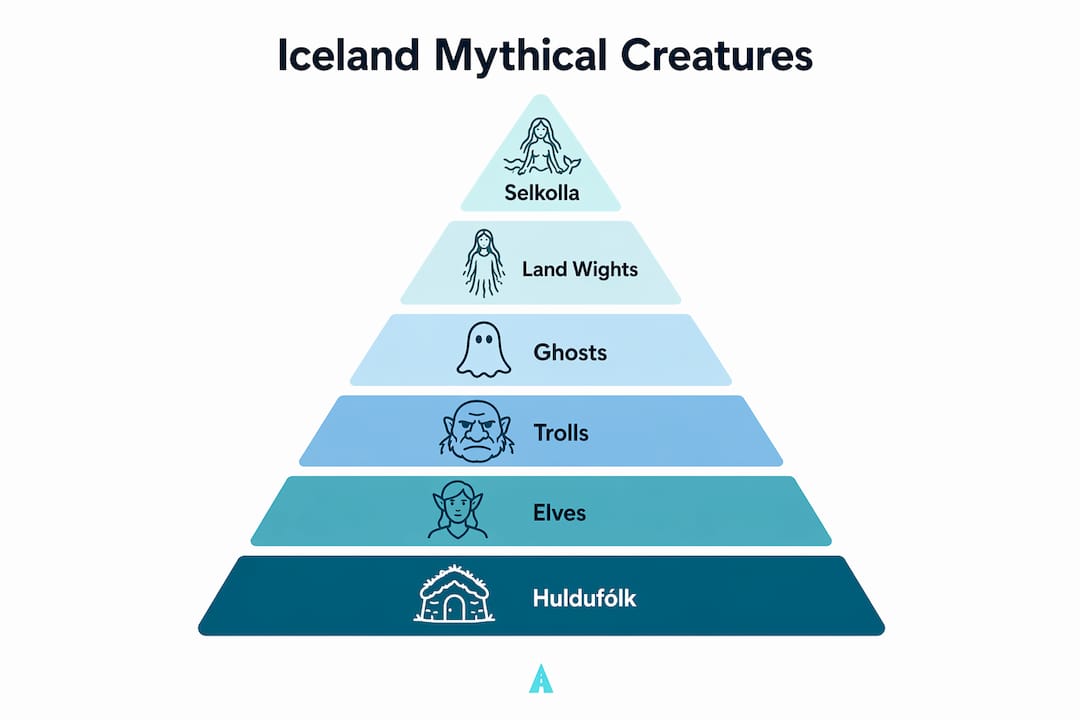
Icelandic mythological creatures fall into several distinct categories, each with specific traits, social rules, and narrative roles. Scholars who treat them as a single undifferentiated group miss the precision that makes this tradition so rich.
Huldufólk (Hidden People)
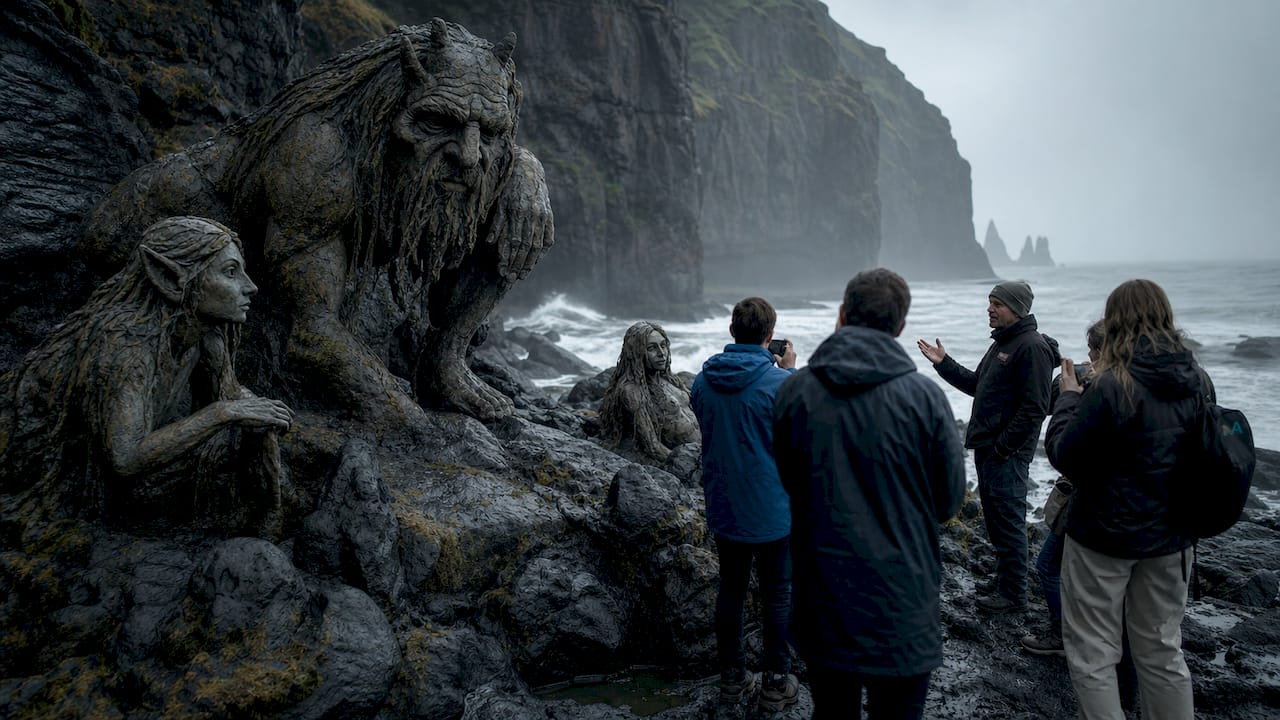
Huldufólk are human-like supernatural beings shaped by Norse and Irish settler influences, linked to origin stories found in medieval sagas. They live in rocks, mounds, and cliffs. Locals approach them with euphemisms to avoid giving offense, because the relationship between humans and hidden people is reciprocal. Disrespect a huldufólk dwelling and you invite misfortune. Treat them with consideration and you earn their goodwill.
Elves
Elves in Icelandic tradition are place-specific beings distinguished by their facial features and long lifespans. They inhabit visible natural landmarks rather than abstract supernatural realms. The cultural sensitivity around them is reflected in the many euphemistic names Icelanders use when referring to them, a practice that signals respect rather than fear. This place-specificity reframes elves as part of landscape identity, not generic fantasy creatures.
Trolls
Trolls occupy a more ambivalent position in Icelandic folk stories. They are large, often dangerous, and associated with remote mountains and lava fields. Many Icelandic place names reference troll encounters, which tells you how deeply these beings are woven into the geography. Unlike huldufólk, trolls are rarely treated as neighbors to be respected. They represent the wild, unpredictable side of Iceland's terrain.
Ghosts and Revenants
Ghost traditions in Icelandic folklore are unusually specific. Icelandic ghosts, called draugar in the older saga literature, are physical revenants rather than transparent apparitions. They haunt specific locations, often tied to unresolved grievances or improper burial. These stories served a clear social function: they reinforced community norms around death rites and property disputes.
Selkolla
Selkolla is one of the most distinctive medieval Icelandic creatures, described as a seal-headed woman whose story appears in versions of Guðmundar saga Arasonar. Her narrative combines Christian exorcism motifs with older Scandinavian pagan elements, and her name explains specific place names in northern Iceland. Selkolla illustrates how myth and Christianization intersected in Iceland's medieval period, producing stories that are neither purely pagan nor purely Christian.
Land Wights (Landvættir)
The four Land Wights, or landvættir, are guardian spirits assigned to Iceland's four quarters: a dragon, an eagle, a bull, and a giant. They appear in the sagas as protectors of the land itself. Iceland's coat of arms still features these four figures today. That continuity from medieval saga to modern national symbol shows how deeply this particular belief has embedded itself in Icelandic identity.
Pro Tip: When visiting Iceland, pay attention to roadside markers near large rocks or unusual stone formations. These often indicate sites where construction was rerouted to avoid disturbing huldufólk dwellings, a practice that continues into the present day.
How do the poetic edda and prose edda shape norse mythology?
The two Eddas are the primary textual sources for Norse mythology, and both were compiled in medieval Iceland. Their origins, purposes, and limitations differ in ways that matter for anyone studying this tradition seriously.
| Text | Date Compiled | Primary Purpose | Key Content |
|---|---|---|---|
| Poetic Edda | c. 13th century | Preserve older mythic poetry | Creation myths, Ragnarök, gods and heroes |
| Prose Edda | c. 1220 CE | Poetic handbook and mythology guide | Cosmology, kennings, skaldic poetry rules |
| Sagas of Icelanders | 13th–14th century | Historical and social narrative | Folk beliefs, supernatural encounters, place lore |
The Poetic Edda is a compilation of mythic and heroic poems drawn from earlier oral tradition. It covers the Norse cosmological cycle from creation through Ragnarök, the destruction and rebirth of the world. The Prose Edda, written by the scholar and chieftain Snorri Sturluson around 1220 CE, was designed as a handbook for poets who needed to understand the mythological references embedded in skaldic verse. Snorri's work is invaluable, but it comes with a critical caveat.
Both texts were written after Christianization, which means the authors filtered older oral material through a Christian intellectual framework. Snorri, for example, presents the Norse gods as ancient kings who were later deified, a rationalization strategy common in medieval Christian writing about pagan traditions. This means scholars must read the Eddas carefully, distinguishing between what reflects genuine pre-Christian belief and what reflects a medieval author's attempt to make pagan myth acceptable to a Christian audience.
Oral tradition preceded both texts by centuries. The poems in the Poetic Edda were likely composed and transmitted orally long before anyone wrote them down. That gap between oral performance and written record introduces layers of change that are impossible to fully reconstruct. Separating Eddic mythic material from later folk belief is therefore a scholarly necessity, not just an academic preference. The two traditions have different evidential statuses and different cultural functions.
How does icelandic folklore reflect the island's landscape?
Icelandic folk belief is inseparable from the physical terrain. The connection between supernatural beings and specific geographical features is the defining characteristic that sets Icelandic folklore apart from most European traditions.
- Rocks and stone formations are the most common dwelling places for huldufólk. Construction projects in Iceland have been delayed or rerouted when workers refused to disturb rocks believed to house hidden people. This is not ancient history. It has happened in the 20th and 21st centuries.
- Lava fields are associated with trolls and dangerous spirits. The Icelandic word hraun (lava field) appears repeatedly in folk narratives as a boundary zone between the human world and the supernatural.
- Cliffs and waterfalls serve as thresholds in many Icelandic folk stories. Specific waterfalls are named after supernatural events, and local communities historically avoided certain cliffs after dark.
- Place names encode mythological memory. Hundreds of Icelandic place names reference troll encounters, elf dwellings, or saga events. The place-specific nature of these beliefs means the landscape itself functions as a living mythological text.
This connection between folk beings and geography is why Iceland's myths feel different from, say, Greek or Roman mythology. Greek myths can be retold anywhere. Icelandic folk beliefs are tied to this rock, this cliff, this lava field. Remove them from the landscape and they lose their meaning.
Contemporary tourism has picked up on this. Guided tours now visit sites associated with elf lore, saga locations, and troll legends. The Icelandic names given to these places carry centuries of mythological meaning that enriches any visit. For travelers interested in the deeper cultural layer beneath Iceland's famous scenery, folklore sites offer a genuinely different perspective.
Pro Tip: Before visiting any folklore site in Iceland, read the local saga or folk story associated with it. The experience of standing at a place you already know from narrative is far more memorable than arriving cold.
What is the cultural significance of icelandic mythology today?
Icelandic mythology functions as a living cultural practice, not a museum exhibit. Its significance in contemporary Iceland shows up across multiple domains.
- Environmental protection: Belief in huldufólk and land wights has been cited in environmental disputes. Activists have invoked folk belief to argue against road construction and industrial development in areas considered spiritually significant. Whether participants hold literal belief or use folklore as cultural shorthand, the practical effect on land use decisions is real.
- Arts and literature: Icelandic writers, filmmakers, and visual artists draw on both Eddic mythology and folk tradition. The novelist Sjón, for example, weaves Norse mythological references into contemporary fiction. The band Sigur Rós has cited Icelandic landscape mythology as a direct influence on their sound.
- Festivals and storytelling: The midwinter festival of Þorrablót celebrates old Norse traditions with food and communal storytelling. It was revived in the 19th century as a cultural identity marker and remains widely observed today.
- Generational change: Younger Icelanders show a more varied relationship with folk belief. Surveys suggest that while literal belief in elves has declined among urban youth, cultural identification with the tradition remains strong. The ethnographic accounts of hidden people traditions show how lived belief functions socially, sustaining myths as community practices rather than mere stories.
- Heritage preservation: The Árni Magnússon Institute in Reykjavík holds the original Eddic manuscripts and actively works to preserve and digitize them. This institutional investment signals how seriously Iceland treats its mythological heritage as a national asset.
The persistence of these traditions across centuries of Christianization, modernization, and globalization is itself significant. Icelandic mythology has survived not because it was frozen in amber but because it kept adapting to new social contexts.
Key takeaways
Icelandic mythology is best understood as two distinct but connected traditions: the Eddic Norse mythological cosmos and the living folk beliefs about hidden people, trolls, and landscape spirits.
| Point | Details |
|---|---|
| Two distinct traditions | Eddic mythology and Icelandic folk belief are separate categories with different evidential status. |
| Landscape is central | Folk beings like huldufólk and trolls are tied to specific rocks, cliffs, and lava fields, not abstract realms. |
| Medieval texts need context | The Poetic and Prose Edda were written after Christianization, which shapes how they present Norse myth. |
| Selkolla shows myth evolution | Her story blends Christian and pagan motifs, illustrating how Icelandic myths adapted over centuries. |
| Mythology remains active | Folk belief influences environmental decisions, arts, and cultural identity in Iceland today. |
Why iceland's mythology deserves more careful reading
Most popular writing about Icelandic mythology collapses two very different things into one category. You get the Norse gods from the Eddas mixed together with huldufólk stories from 19th-century folk collections, presented as if they are the same tradition. They are not. The Eddas preserve a cosmological system with specific gods, creation narratives, and an eschatology. Icelandic folk belief is something else: a pragmatic, place-specific set of social practices organized around supernatural neighbors.
What I find genuinely compelling about this tradition is how the folk belief side has outlasted the Eddic mythology in practical terms. Most Icelanders do not organize their lives around Odin or Thor. But a meaningful number still think twice before disturbing a particular rock. That is not superstition in any dismissive sense. It is a form of cultural memory encoded in behavior, and it tells you something important about how communities transmit values across generations without formal institutions.
The other thing worth noting: the Eddas are not straightforward windows into Viking belief. Snorri Sturluson was a 13th-century Christian intellectual writing about a tradition that was already several generations removed from living practice. Reading him as a direct source for pre-Christian Norse religion is like reading a medieval Christian commentary on Roman religion and treating it as primary evidence. You can learn a great deal from Snorri, but you have to read him critically.
If you are approaching Icelandic mythology seriously, start with the Poetic Edda in a good translation, then read the folk collections separately. Keep the categories distinct. The reward is a much richer understanding of both traditions on their own terms.
— Sergiu
Explore iceland's mythological landscape with Easytransfer
Iceland's mythology is not just something you read about. It is something you can stand inside. The lava fields associated with troll legends, the rocks tied to huldufólk traditions, and the saga sites where medieval stories unfolded are all reachable by road.

Easytransfer offers private transfers across Iceland that get you to these sites comfortably and on your own schedule. Whether you want to visit the Golden Circle's saga landmarks or reach remote folklore sites in the north, Easytransfer's fleet of premium vehicles handles the logistics. Fixed pricing, flight tracking, and 24/7 support mean you focus on the experience, not the transportation. Get a quote at easytransfer.is and a sales agent will respond within 24 hours.
FAQ
What is iceland mythology, exactly?
Iceland mythology refers to two connected traditions: the Norse mythological system preserved in medieval Icelandic manuscripts like the Poetic Edda and Prose Edda, and the local folk beliefs about hidden people, trolls, ghosts, and landscape spirits. Scholars treat these as distinct categories with different origins and evidential status.
Who are the huldufólk in icelandic folklore?
Huldufólk are hidden people in Icelandic folk tradition, described as human-like beings who live in rocks and natural features. They reflect a blend of Norse and Irish settler influences and are approached with respect and euphemistic language to maintain good relations.
What is the difference between the poetic edda and prose edda?
The Poetic Edda is a collection of older mythic and heroic poems compiled in the 13th century, while the Prose Edda was written by Snorri Sturluson around 1220 CE as a handbook for skaldic poets. Both were written after Iceland's Christianization, which affects how they present pre-Christian Norse belief.
Are beliefs in icelandic mythical creatures still active today?
Yes. Belief in huldufólk and elves persists in Iceland, influencing construction decisions and environmental debates. The living folk tradition functions as a community practice, not just a historical curiosity, though literal belief varies across generations.
What is selkolla in icelandic mythology?
Selkolla is a seal-headed supernatural woman from medieval Icelandic folk narrative, appearing in versions of Guðmundar saga Arasonar. Her story combines Christian exorcism motifs with older Scandinavian pagan elements and explains the origin of specific place names in northern Iceland.