
TL;DR:
- Iceland's history begins with Viking settlement in 874 AD and the founding of the Althing in 930 AD, one of the world's oldest parliaments. It endured over 550 years of foreign rule under Norway and Denmark before gaining independence in 1944 through a popular referendum. This long democratic tradition, resilience, and institutional development shape modern Iceland's prosperous, egalitarian society today.
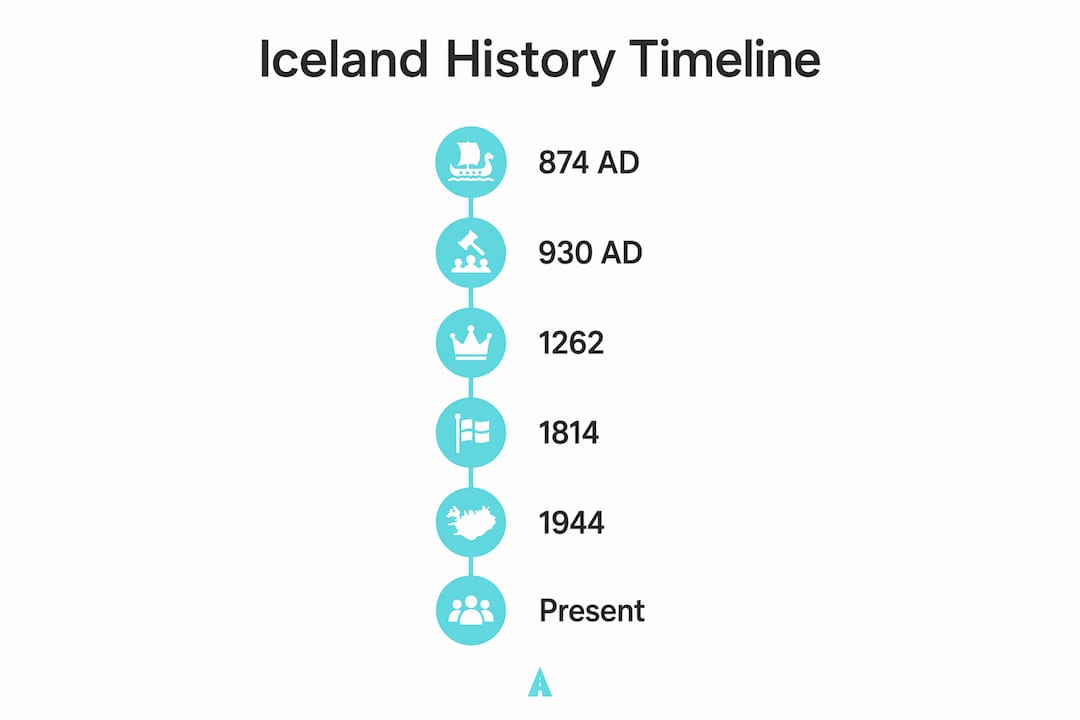
Iceland's history timeline is the structured record of major events that shaped the nation from its first Viking settlement in 874 AD to its modern republic, covering more than 1,100 years of cultural, political, and religious transformation. Few countries pack as much dramatic change into their past as Iceland. The settlement of Iceland began with Norse chieftain Ingólfr Arnarson establishing Reykjavík, and from that single act of settlement grew a nation with one of the world's oldest parliaments, a turbulent period of foreign rule, and a 20th-century independence movement that produced a republic by popular vote. Understanding this timeline gives you direct access to why Iceland thinks, governs, and identifies the way it does today.
What does the iceland history timeline cover from 874 to 1262?
The earliest chapter of Iceland's inhabited history runs from the first Norse settlement in 874 AD through the end of the independent Icelandic Commonwealth in 1262. This period established the cultural and political foundations that still echo in Icelandic identity today.
The key events in this era unfold in a clear sequence:
- 874 AD: Ingólfr Arnarson, recorded in the Landnámabók as the first permanent Nordic settler, arrives and establishes Reykjavík. He is followed by waves of Norse and Gaelic settlers fleeing political pressures in Scandinavia and the British Isles.
- 930 AD: The Althing is founded as a legislative and judicial assembly, making it one of the world's oldest parliaments. Chiefs from across the island gathered annually at Þingvellir to pass laws and settle disputes.
- 999–1000 AD: Iceland converts to Christianity, a decision made at the Althing itself. The lawspeaker Þorgeirr Ljósvetningagoði famously mediated between pagan and Christian factions, choosing Christianity to preserve social unity.
- 13th century: The Age of the Sturlungs brings internal clan warfare. Powerful families, including the Sturlungar clan, fight for dominance, weakening the Commonwealth's ability to govern.
- 1262: Exhausted by civil war, Icelandic chieftains submit to Norwegian King Hákon Hákonarson, ending the Commonwealth era.
What makes this period remarkable is the Althing's unique combination of legislative, judicial, and executive functions, which laid the foundation for Iceland's democratic principles long before most European nations had comparable institutions. Early Icelandic settlers also valued consensus over majority rule, a Norse democratic tradition that shaped how the assembly operated for centuries.
Pro Tip: If you visit Þingvellir National Park today, you are standing on the exact site where the Althing convened for centuries. The rift valley there is also where the North American and Eurasian tectonic plates meet, making it one of the most historically and geologically significant locations on Earth.
How did foreign rule change Iceland between 1262 and 1814?
The Old Covenant signed in 1262 to 1264 ended the Icelandic Commonwealth and transferred sovereignty to Norway. This transition marked the start of more than 550 years of foreign governance, during which Iceland's religious, economic, and social fabric was fundamentally reshaped.
Key developments during this long period of foreign rule include:
- Norwegian sovereignty (1262–1380): Iceland falls under the Norwegian crown. Norwegian law replaces the old Commonwealth legal code, and royal officials replace the independent chieftains.
- Kalmar Union and Danish control (1380–1814): When Norway enters the Kalmar Union, Iceland passes to Danish authority. Denmark consolidates control and eventually imposes a strict trade monopoly that limits Iceland's economic freedom.
- Lutheranism imposed in 1550: King Christian III of Denmark enforces the Protestant Reformation in Iceland. The last Catholic bishop, Jón Arason, is beheaded, marking a forced and violent end to Catholicism on the island.
- Danish trade monopoly (1602–1787): Denmark divides Iceland into trading districts and grants exclusive rights to Danish merchants. Icelanders cannot trade freely, suppressing economic development for nearly two centuries.
- Volcanic catastrophe (1783): The Laki eruption triggers the Mist Hardships, one of the worst disasters in Icelandic history.
The Laki volcanic eruptions of 1783 caused famine and the loss of 20 to 25% of Iceland's population. This single event reshaped Iceland's demographics and deepened its economic vulnerability under Danish rule, making recovery even more difficult.
The table below summarizes the major governance shifts during this era:
| Period | Ruling Power | Key Change |
|---|---|---|
| 1262–1380 | Kingdom of Norway | End of Commonwealth; Norwegian law imposed |
| 1380–1814 | Kingdom of Denmark | Trade monopoly; full Danish administrative control |
| 1550 | Danish Crown | Lutheranism enforced; Catholic Church abolished |
| 1783 | Danish Crown | Laki eruption causes mass famine and population loss |
One underappreciated fact about this period is that Iceland and Greenland history share a parallel thread here. Both territories were Norse-settled, both came under Norwegian and then Danish authority, and both experienced the same pattern of distant colonial administration that prioritized the crown's interests over local welfare.
How did Iceland win independence between 1814 and 1944?
The road from Danish colony to independent republic took 130 years and required a combination of intellectual nationalism, constitutional negotiation, and the geopolitical disruptions of two world wars.
The independence movement followed a clear progression:
- 1814: The Treaty of Kiel transfers Norway to Sweden but keeps Iceland under Danish rule. Icelanders receive no say in this arrangement, fueling resentment.
- 1830s–1870s: The 19th-century independence movement is led by Jón Sigurðsson, a scholar and politician who argues for Icelandic autonomy based on historical rights and nationalist principles. His work directly inspires constitutional reform.
- 1845: The Althing is reinstated after being suspended from 1799 to 1845. Its restoration is a critical symbolic and practical victory for Icelandic nationalism.
- 1874: Denmark grants Iceland its first constitution and limited home rule, coinciding with the 1,000th anniversary of settlement. This is the first formal recognition of Icelandic self-governance in centuries.
- 1904: Home rule expands significantly. Iceland gains its own minister resident in Reykjavík, giving the island real administrative autonomy for the first time.
- 1918: The Danish–Icelandic Act of Union establishes Iceland as a sovereign state in personal union with Denmark, sharing only the monarchy. Iceland controls its own foreign affairs and domestic policy.
- 1940: Germany occupies Denmark. British and then United States forces occupy Iceland due to its strategic North Atlantic position. Iceland manages its own defense and international relations independently.
- 1944: Iceland holds a referendum. 97% of voters choose to sever ties with Denmark entirely. On June 17, 1944, the Republic of Iceland is proclaimed at Þingvellir, with Sveinn Björnsson as the first president.
Pro Tip: June 17 is Iceland's National Day, chosen specifically because it is Jón Sigurðsson's birthday. When you visit Iceland in summer, you will see nationwide celebrations on this date that directly connect the modern republic to its independence movement.
For travelers planning a visit around these cultural milestones, check out these Iceland travel tips to make the most of your time at historically significant sites.
What defines modern Iceland from 1944 to the present?
Iceland's modern era begins with the founding of the republic and accelerates through economic transformation, international integration, and political evolution. The country that emerged from World War II as a newly independent republic became one of the world's most prosperous and stable democracies within a generation.
- 1944: Iceland's constitution is instituted on June 17, establishing the governance structure and human rights framework. The constitution has been amended seven times since, with crowd-sourced amendments proposed after 2008 still awaiting full implementation.
- 1948–1952: Iceland receives Marshall Plan aid from the United States, accelerating post-war economic recovery and modernizing infrastructure.
- 1949: Iceland becomes a founding member of NATO, cementing its Western alliance despite having no standing army. This decision shapes Iceland's foreign policy for decades.
- 1946: Iceland joins the United Nations, entering the international community as a fully recognized sovereign state.
- Economy: Iceland's economy shifts from subsistence fishing to industrial fishing, then diversifies into finance, tourism, and biotechnology. The 2008 financial crisis hits Iceland harder than almost any other country, but the government's unconventional recovery strategy, including letting banks fail and prioritizing citizens over creditors, produces a faster rebound than most economists predicted.
- Tourism boom: By the 2010s, Iceland becomes one of the fastest-growing tourist destinations in the world. Visitor numbers grow from roughly 500,000 per year in 2010 to over 2 million by 2018, transforming the economy and infrastructure.
- Political milestones: Iceland elected Vigdís Finnbogadóttir as president in 1980, making her the world's first democratically elected female head of state. This milestone reflects the egalitarian values rooted in Iceland's long democratic tradition.
Modern Iceland is a direct product of its historical timeline. The democratic instincts formed at the Althing in 930, the resilience built through centuries of foreign rule and natural disasters, and the nationalist determination of the 19th century all converge in the stable, outward-looking republic you see today.
Key takeaways
Iceland's history timeline spans over 1,100 years, from Viking settlement in 874 AD through the founding of the world's oldest parliament to a modern republic built on democratic tradition and hard-won independence.
| Point | Details |
|---|---|
| Settlement begins in 874 AD | Ingólfr Arnarson establishes Reykjavík, starting Iceland's recorded inhabited history. |
| Althing founded in 930 AD | One of the world's oldest parliaments, combining legislative and judicial powers from the start. |
| Foreign rule spans 550+ years | Norwegian and Danish control from 1262 to 1944 reshaped Iceland's religion, economy, and law. |
| Independence achieved in 1944 | A 97% referendum vote produced the republic, with Sveinn Björnsson as first president. |
| Modern Iceland reflects its past | Democratic values, resilience, and national identity all trace directly to historical milestones. |
Why Iceland's history timeline matters more than most people realize
People often treat Iceland's history as a footnote to Viking mythology or a backdrop for geysers and glaciers. That reading misses the point entirely.
What strikes me most about Iceland's historical timeline is how consistently the country punched above its weight. A population that never exceeded a few hundred thousand people produced one of the world's oldest functioning democratic institutions, survived centuries of colonial neglect and volcanic catastrophe, and then built a modern republic that ranks among the most literate, equal, and prosperous societies on Earth. That is not an accident. It is the direct result of specific historical choices made at specific moments.
The Althing is the clearest example. Most medieval societies resolved disputes through force or royal decree. Iceland built a parliament. The consensus-based decision-making that characterized early Norse democratic traditions was not just a political quirk. It was a survival mechanism for a small, isolated population that could not afford prolonged internal conflict. That same instinct toward negotiation and compromise shows up in Iceland's peaceful transition to independence in 1944 and in its unconventional response to the 2008 financial crisis.
The parallel with Greenland is also worth noting. Both islands share Norse roots and Danish colonial history, but their trajectories diverged sharply after the 20th century. Iceland's independence movement, anchored by Jón Sigurðsson's intellectual nationalism and the restored Althing, gave it the institutional tools to become a republic. Greenland remains a Danish territory today. History is not destiny, but institutions matter enormously.
For anyone visiting Iceland, knowing this timeline transforms what you see. Þingvellir is not just a scenic rift valley. It is the birthplace of Western democratic tradition. Reykjavík is not just a quirky capital. It is the site where a Norse chieftain made a permanent home in 874 and where a nation grew from that single act of settlement.
— Sergiu
Explore Iceland's history with Easytransfer
Iceland's historical sites are spread across the entire island, from Þingvellir in the southwest to remote volcanic landscapes in the interior. Getting between them comfortably and on your own schedule makes a real difference in how much you absorb and enjoy.
Easytransfer provides private transfers across Iceland from Keflavík Airport to Reykjavík, the Golden Circle, Blue Lagoon, Sky Lagoon, and beyond. Vehicles include Mercedes models and Tesla electric cars, with fixed pricing, flight tracking, and 24/7 support included. If you want a private tour of the Golden Circle, which covers Þingvellir, Geysir, and Gullfoss, read about why private tours work better for history-focused visits. Groups of up to 49 passengers are accommodated, and you can get a custom quote for any route across Iceland within 24 hours.
FAQ
When did Iceland's history begin?
Iceland's recorded history begins in 874 AD when Norse chieftain Ingólfr Arnarson established a permanent settlement at Reykjavík, as documented in the Landnámabók.
What is the Althing and why is it significant?
The Althing is Iceland's parliament, founded in 930 AD, making it one of the world's oldest legislative assemblies. It combined legislative, judicial, and executive functions and served as the central institution of the Icelandic Commonwealth until 1262.
When did Iceland become an independent republic?
Iceland became a republic on June 17, 1944, after a referendum in which 97% of voters chose to sever ties with Denmark. Sveinn Björnsson was inaugurated as the first president on the same day.
How did foreign rule affect Iceland's development?
Foreign rule under Norway and then Denmark from 1262 to 1944 imposed new legal systems, forced religious conversion to Lutheranism in 1550, and restricted trade through a Danish monopoly. The Laki eruption of 1783 compounded these pressures by wiping out 20 to 25% of the population.
What is the connection between Iceland and Greenland history?
Both Iceland and Greenland were settled by Norse explorers and later came under Norwegian and Danish colonial rule. Iceland achieved full independence in 1944, while Greenland remains a self-governing territory within the Kingdom of Denmark, making their post-colonial paths a study in contrasting outcomes.