

TL;DR:
- Licensed, regulated transfer providers with verified credentials and strong encryption ensure safer transactions. Verifying legitimacy through official databases and confirming security features like HTTPS, 2FA, and segregated funds protect travelers from scams. Using credit cards initially and avoiding wire transfers reduce financial risk during international transfers.
The safest transfer options are defined by licensed, regulated providers that combine verified credentials, strong encryption, and transparent customer protections. Knowing how to select safest transfer options before you book can mean the difference between a smooth arrival in Reykjavík and a stressful, costly mistake. Regulated providers maintain fraud rates below 0.1% by value, a figure that reflects what proper licensing, 256-bit AES encryption, and two-factor authentication actually deliver in practice. This guide walks you through every step, from verifying a provider's credentials to choosing the right payment method and spotting scams before they reach you.
How to select safest transfer options: the core criteria
Verifying a provider's legitimacy is the first and most important step. A licensed transfer service will appear in an official regulatory database. For financial transfers, the FinCEN MSB Registrant Search covers US-registered providers, while the FCA Register covers those operating in the UK. Checking these official databases is the baseline for confirming a provider is legitimate. If a company does not appear in either registry, treat that as a firm reason to look elsewhere.
Beyond regulatory status, look for a secure connection every time you visit a booking or payment page. The URL must begin with "https://" and your browser should display a padlock icon. These signals confirm the site uses SSL/TLS encryption to protect data you submit. A missing padlock on a payment page is a red flag, full stop.
Two-factor authentication, or 2FA, is the next non-negotiable feature. A provider that does not offer 2FA leaves your account vulnerable to credential theft. Read the provider's security policy page carefully. Vague language like "we take security seriously" without specific technical details is a warning sign. Concrete statements about encryption standards, identity verification processes, and account protection protocols indicate a provider that has actually built safety into its operations.
Pro Tip: Before booking any transfer service, search the provider's name alongside the word "scam" or "complaint" in Google. Genuine safety problems surface quickly in travel forums and consumer review sites.
What security features actually protect your transfer?
The technical layer of a safe transfer service rests on two core standards. 256-bit AES encryption combined with TLS 1.3 secures data both in transit and at rest. That means your personal details and payment information are protected from the moment you submit them to the moment they reach the provider's servers.
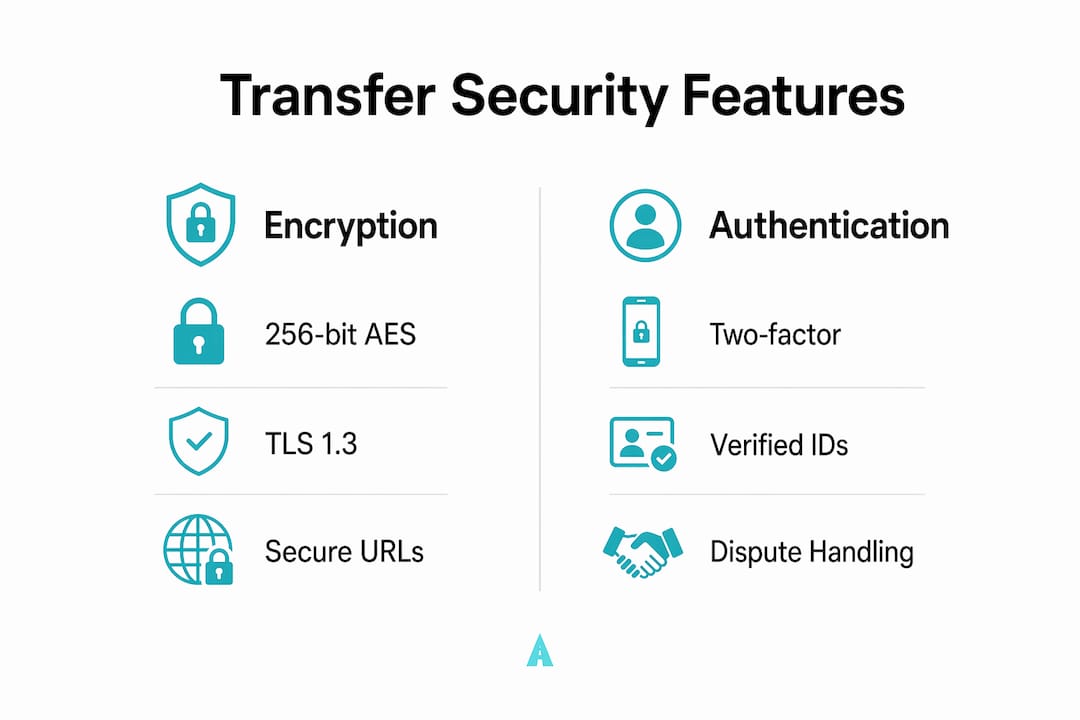
Two-factor authentication adds a second line of defense that encryption alone cannot provide. Even if a bad actor obtains your password, 2FA blocks access without the second verification step, typically a code sent to your phone. This directly counters social engineering attacks, which are now the primary threat vector for travelers booking transfers online.
Real-time fraud monitoring is another feature worth confirming. Reputable providers run automated systems that flag unusual activity, such as a booking made from an unfamiliar device or location, and pause the transaction for review. Identity verification processes, where the provider checks your ID against booking details, add another layer that protects both you and the service.
Providers that hold customer funds in segregated accounts offer a protection most travelers overlook. If a company faces insolvency, ring-fenced funds remain legally separate from company assets. Your money stays protected even if the business fails.
- Regulatory authorization: Confirm the provider appears in FinCEN or FCA databases before booking.
- Encryption standards: Look for explicit mention of 256-bit AES and TLS 1.3 in the security policy.
- Two-factor authentication: Verify 2FA is available and enabled on your account.
- Segregated accounts: Check whether customer funds are held separately from operating funds.
- Real-time fraud monitoring: Confirm the provider uses automated systems to detect unusual activity.
Pro Tip: Ask the provider directly, via email or chat, how they handle a disputed or unauthorized booking. A fast, specific answer signals a well-run operation. A vague or delayed response tells you something important.
How should you fund your transfer to stay protected?
Payment method choice directly affects your ability to recover funds if something goes wrong. Credit card transfers provide chargeback protection under regulations like the Fair Credit Billing Act (FCBA) in the US, giving you a formal dispute process if a provider fails to deliver.
The recommended approach for booking with a new provider follows a clear sequence:
- Use a credit or debit card for your first booking. This gives you chargeback rights and lets you verify the provider's reliability before committing to larger payments.
- Confirm the booking details and service delivery. Check that the vehicle arrived on time, the driver matched the booking, and the route was correct.
- Switch to bank transfer for future bookings once you have confirmed the provider is trustworthy. Bank transfers typically carry lower fees but offer limited recourse if something goes wrong.
- Avoid wire transfers for first-time bookings. Wire transfers are highly secure but almost irreversible, meaning you have little recourse if the provider does not deliver.
- Watch for credit card cash advance fees. Some providers process card payments as cash advances rather than purchases, triggering higher interest rates. Confirm the transaction type with your card issuer before paying.
Balancing fees and security is a real consideration. Specialized transfer services charge fees of 0.5–1.5%, while traditional bank wires often exceed 7% in total cost. The fee difference matters, but it should never override the need to verify a provider's credentials first.
What social engineering scams target travelers during bookings?
Most unauthorized fund losses come from social engineering scams, not technical breaches. Phishing emails that impersonate transfer providers are the most common tactic. These messages often look identical to legitimate booking confirmations, complete with logos and formatting, but direct you to a fake payment page designed to steal your card details.
Fake websites are a related threat. Scammers register domain names that closely resemble legitimate providers, sometimes changing a single letter or adding a word like "official" or "secure." Always type the provider's URL directly into your browser rather than clicking a link in an email or social media post.
"Sharing a password and a link in the same message is one of the most common security mistakes travelers make. Using separate communication channels for passwords and links, known as out-of-band authentication, drastically reduces the risk of unauthorized interception."
Verifying recipient details before completing any payment is a step many travelers skip under time pressure. Confirm the account name, reference number, and amount match your original booking confirmation exactly. A discrepancy, even a small one, warrants a direct call to the provider before you proceed.
How to choose between different transfer service types
The safest approach depends on your specific context and travel needs, not on a single universal rule. Private, licensed transfer services offer the clearest accountability. They provide documented driver credentials, insured vehicles, and a fixed point of contact if something goes wrong. Informal or unregulated options may cost less upfront, but they carry real risks: no insurance, no accountability, and no recourse if the driver does not show.

| Feature | Licensed private transfer | Informal or unregulated option |
|---|---|---|
| Driver credentials | Verified and documented | Unverified |
| Vehicle insurance | Confirmed coverage | Often absent |
| Fixed pricing | Yes, no hidden fees | Variable, often unclear |
| Cancellation policy | Defined terms | Typically none |
| Customer support | 24/7 contact available | Limited or none |
| Accountability | Regulated provider | No formal recourse |
Balancing convenience, cost, and security according to your trip priorities is the practical framework here. For airport transfers in an unfamiliar country like Iceland, the stakes of choosing an unregulated provider are higher than they might be at home. A missed pickup at Keflavík Airport at 2:00 AM in winter is not a minor inconvenience.
Test bookings are an underused verification tool. Book a short, low-cost transfer first to confirm the provider's punctuality, vehicle quality, and communication. Services like Easytransfer offer airport transfer guides that walk you through the booking process step by step, which itself signals a provider committed to transparency. A provider that explains its process clearly is one that has nothing to hide.
For group travel, confirm the vehicle capacity matches your party size before booking. Easytransfer's fleet accommodates up to 49 passengers, with options including Mercedes models and Tesla electric vehicles. That level of specificity in fleet information is itself a trust signal.
Key Takeaways
The safest transfer options combine regulatory authorization, strong encryption, 2FA, segregated customer funds, and a credit card payment for your first booking.
| Point | Details |
|---|---|
| Verify regulatory status | Check FinCEN or FCA databases before booking any transfer provider. |
| Confirm encryption and 2FA | Look for 256-bit AES, TLS 1.3, and two-factor authentication in the security policy. |
| Use a credit card first | Chargeback rights under the FCBA protect you when booking with a new provider. |
| Watch for social engineering | Phishing and fake websites cause more losses than technical breaches. |
| Choose licensed providers | Regulated services offer documented drivers, insured vehicles, and defined cancellation terms. |
What I've learned about picking safe transfers after years of travel
Travelers consistently underestimate how much the provider selection process matters compared to the transfer itself. The actual ride or transaction is rarely where things go wrong. Problems almost always trace back to the booking stage: an unverified provider, a payment made without chargeback protection, or a link clicked in a suspicious email.
The advice I give anyone planning an international trip is simple. Spend ten minutes on the regulatory database check before you spend a single dollar. That ten minutes has saved more than a few travelers I know from losing both money and time in an unfamiliar country. Price should be the last filter you apply, not the first.
Scam tactics are also getting harder to spot. Fake booking confirmation emails now replicate provider branding with near-perfect accuracy. The tell is almost always the URL. Train yourself to check the domain name before entering any payment details, every single time, without exception.
The layered approach works: verify the provider, secure your payment method, and communicate carefully. No single step is sufficient on its own. A licensed provider with weak payment protections still leaves you exposed. A strong payment method used with an unverified provider gives you recourse but not safety. All three layers together are what actually protect you.
Premium services that invest in safety, like Easytransfer's personalized transfer options for Iceland travelers, make the verification process easier because the information is already transparent and publicly available. That transparency is not accidental. It is the mark of a provider that expects scrutiny and welcomes it.
— Sergiu
Easytransfer: a safe, licensed transfer option for Iceland
Easytransfer is a licensed private transfer service based in Iceland, built specifically for international travelers who need reliable, accountable transportation between Keflavík Airport, Reykjavík, the Blue Lagoon, and the Sky Lagoon.

Every booking with Easytransfer includes fixed pricing with no hidden fees, instant confirmation, flight tracking, and 24/7 customer support. The fleet covers individual travelers and groups up to 49 passengers, with vehicles including Mercedes models and Tesla electric cars. Cancellations made at least 24 hours in advance receive a full refund. For travelers who want to apply the safety criteria in this guide without doing the research from scratch, Easytransfer's private transfer services in Iceland meet every standard covered here: licensed, insured, transparent, and professionally operated.
FAQ
What makes a transfer provider safe to use?
A safe transfer provider holds valid regulatory authorization, uses 256-bit AES encryption and TLS 1.3, offers two-factor authentication, and holds customer funds in segregated accounts. Fraud rates among properly regulated providers stay below 0.1% by value.
How do I verify a transfer provider's credentials?
Search the provider's name in the FinCEN MSB Registrant Search for US-based services or the FCA Register for UK-based ones. A legitimate provider will appear in at least one official database.
What payment method is safest for a first-time transfer booking?
A credit card is the safest option for a first booking because it provides chargeback rights under the FCBA in the US, giving you a formal dispute process if the provider fails to deliver.
How can I spot a fake transfer booking website?
Check the URL directly in your browser's address bar before entering any payment details. Fake sites often use domain names that closely resemble legitimate providers, with minor spelling changes or added words like "official."
Are private transfers safer than informal transport options?
Licensed private transfers offer verified driver credentials, insured vehicles, fixed pricing, and defined cancellation terms. Informal options carry no formal accountability, no insurance, and no recourse if the service fails.