

Flying directly to Keflavík International Airport (KEF) is the fastest and most practical way to reach Iceland from the United States. Nonstop service is available from multiple U.S. cities, connecting flights via European hubs add flexibility, and seasonal cruises offer a slower, scenic alternative. Here's how each option stacks up at a glance:
- Nonstop flights to KEF — Best for speed and simplicity; available from East Coast, Midwest, and select West Coast cities
- Connecting flights via Europe or the U.K. — Best for budget travelers or those combining Iceland with another European destination
- Transatlantic repositioning cruises — Best for travelers who want a scenic, unhurried experience and have extra time
- Fly-cruise combinations — Best for cruise lovers who want Iceland as a port of call without a full ocean crossing
One thing every traveler needs to plan before landing: KEF sits on the Reykjanes Peninsula, roughly 50 km from Reykjavík. The drive takes about 45 to 50 minutes, so your onward transport from the airport deserves as much thought as the flight itself.
Key Takeaways
Flying nonstop to Keflavík International Airport (KEF) is the fastest way to reach Iceland from the U.S., with East Coast flights taking 5–6 hours and the 50 km transfer to Reykjavík adding roughly 45–50 minutes.
| Point | Details |
|---|---|
| Nonstop flights from the U.S. | Icelandair and PLAY offer direct service from multiple U.S. cities; East Coast flights run 5–6 hours. |
| KEF transfer planning | KEF is 50 km from Reykjavík; choose Flybus, taxi, or a pre-booked private transfer based on group size and arrival time. |
| Entry rules for U.S. citizens | Visa-free for up to 90 days in Schengen; passport must be valid 3 months beyond Schengen departure; EES biometrics apply. |
| Cruise season is limited | Iceland cruise port calls run May through September; fly-cruise is the most common format for U.S. travelers. |
| Easytransfer for arrivals | Pre-book a private transfer with flight tracking and fixed pricing for a reliable, comfortable ride from KEF. |
Table of Contents
- How do you get to Iceland by flight from the U.S.?
- What should you expect when arriving at Keflavík Airport?
- When does routing through Europe or the U.K. make sense?
- Can you cruise to Iceland from the United States?
- How long does the trip take, and what does it cost?
- What entry rules apply to U.S. citizens visiting Iceland?
- How does the season you travel in affect your options?
- A practical perspective on getting your Iceland trip right
- Easytransfer makes your KEF arrival stress-free
- Sources
How do you get to Iceland by flight from the U.S.?
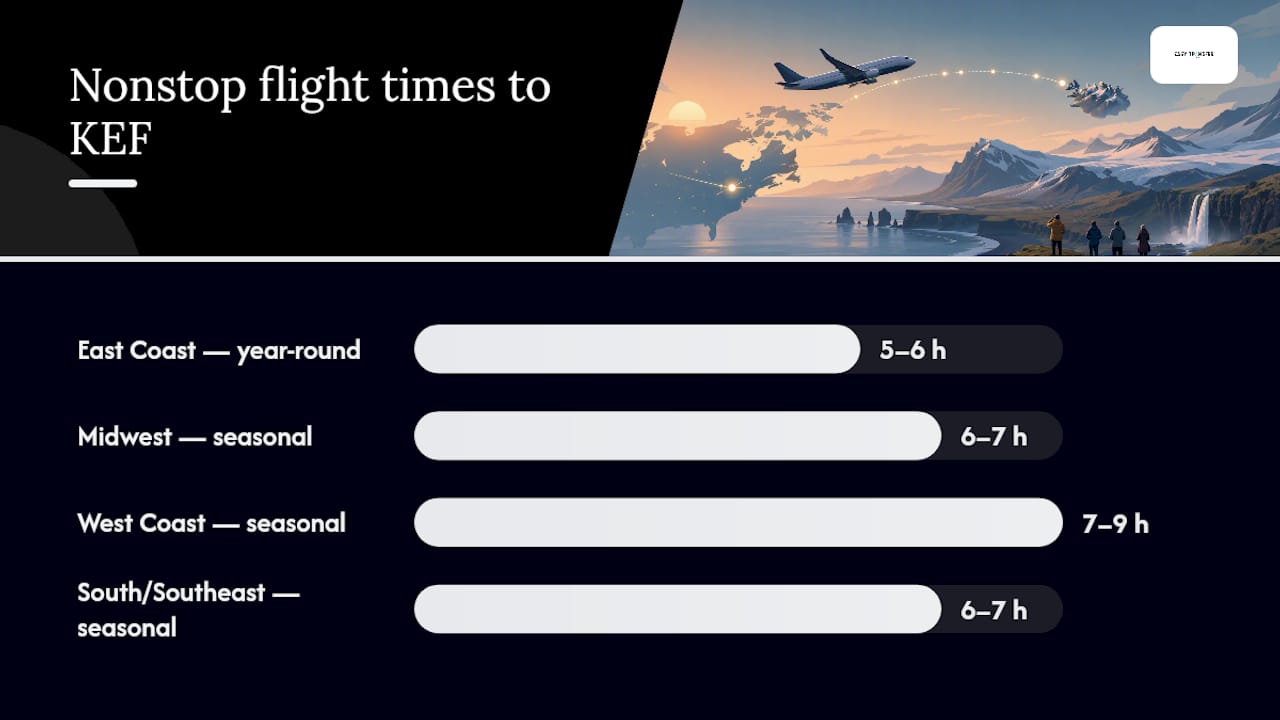
Flying is the primary way to reach Iceland from the United States, and the route options have expanded considerably in recent years. Nonstop flights to KEF depart from a growing list of U.S. gateway cities, with East Coast flights typically taking between 5 and 6 hours, Midwest departures between 6 and 7 hours, and West Coast routes approximately 7 to 9 hours.
Icelandair operates the widest network of U.S. routes to KEF, with nonstop service from cities including New York (JFK), Boston (BOS), Washington Dulles (IAD), Chicago O'Hare (ORD), Denver (DEN), Minneapolis (MSP), Seattle (SEA), Portland (PDX), Baltimore (BWI), and Orlando (MCO). PLAY, Iceland's low-cost carrier, offers nonstop service from select East Coast and mid-Atlantic airports at lower base fares, though with fewer included amenities. Delta Air Lines and United Airlines operate codeshare arrangements on certain Iceland routes, which means you can book through familiar U.S. carriers while flying on Icelandair metal.
| Departure Region | Example Gateway | Typical Nonstop Availability | Typical Nonstop Flight Time |
|---|---|---|---|
| East Coast | New York (JFK), Boston (BOS) | Year-round (peak summer) | 5–6 hours |
| Midwest | Chicago (ORD), Minneapolis (MSP) | Seasonal (spring–fall) | 6–7 hours |
| West Coast | Seattle (SEA), Portland (PDX) | Seasonal (summer) | 7–9 hours |
| South/Southeast | Orlando (MCO), Baltimore (BWI) | Seasonal (summer) | 6–7 hours |
Connecting itineraries typically route through London Heathrow, Amsterdam Schiphol, Copenhagen, or Reykjavik-adjacent European hubs. They add 2–6 hours to your total travel time depending on the layover, but they often cost noticeably less than nonstop tickets, especially outside peak summer season.
Pro Tip: Icelandair's free stopover program lets you spend up to seven nights in Iceland at no extra airfare cost when booking a transatlantic itinerary to another European destination. If you want to combine Iceland with a trip to Scandinavia or the U.K., this is one of the most underused deals in transatlantic travel.
Seasonal route changes matter here. Several Icelandair and PLAY routes operate only from May through October. If you're planning a winter trip for the Northern Lights, confirm that your preferred departure city still has direct service in the winter months before you book.
What should you expect when arriving at Keflavík Airport?
KEF is Iceland's main international gateway, and its layout is straightforward once you know what to expect. Arrivals flow from the gate through passport control, baggage claim, and customs in a single terminal. Car rental counters are in the arrivals hall, and transfer pickup points for buses and private vehicles are just outside the terminal doors.
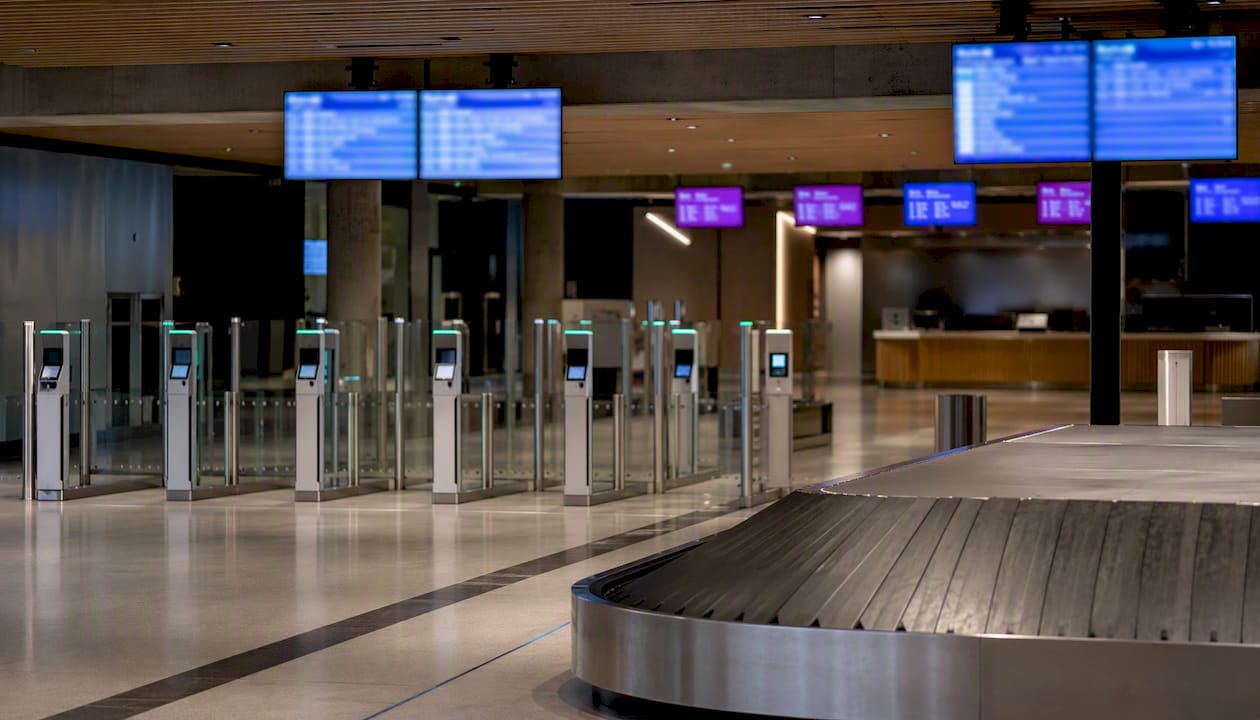
Morning transatlantic arrivals and afternoon European waves create concentrated periods where immigration and baggage wait times can be lengthy. If you have a tight onward connection, a cruise embarkation, or a tour starting the same day, build in that buffer.
Step-by-step arrival sequence:
- Deplane and follow signs to Passport Control (non-EU/EEA travelers use the designated lane)
- Present your passport; expect biometric capture (photo and fingerprints) under the EU Entry/Exit System (EES) when in operation
- Collect checked baggage at the carousel
- Pass through Customs (green channel for nothing to declare)
- Pick up currency or confirm your card works at the ATM near arrivals (most services in Iceland accept Visa and Mastercard)
- Head to your transfer pickup point: buses depart from the designated bay; private transfers meet you in arrivals
Here's how the main transfer options compare for the ~50 km ride into Reykjavík:
| Transfer Option | Typical Price to Reykjavík | Travel Time | Booking Required | Best For |
|---|---|---|---|---|
| Flybus / Airport Express | ~$30–$45 per person | 45 to 50 minutes (hotel drop adds time) | Recommended for hotel drop-off | Solo travelers, budget-conscious |
| Strætó airport shuttle | Lower-cost option | 45 to 50 minutes | No pre-booking required | Budget travelers, flexible timing |
| Licensed taxi (KEF taxis) | approximately $120 to $180 per ride | 45–50 min | No pre-booking required | Small groups, immediate departure |
| Private transfer (e.g., Easytransfer) | Fixed price, varies by vehicle | 45–50 min | Pre-book online | Families, groups, premium comfort |
Flybus and Airport Express run scheduled services and are reliable for solo travelers or pairs on a budget. Flybus drops you at the BSÍ bus terminal in Reykjavík, with a connecting shuttle to most hotels. Strætó provides a non-pre-book shuttle option at certain hours. Licensed taxis wait curbside immediately outside arrivals, with fares typically falling within a moderate range depending on passenger count and time of day.
Pro Tip: Pre-booking a private transfer pays off most for late-night arrivals, large groups, or winter travel when bus schedules thin out. Services with flight tracking adjust your pickup time automatically if your flight is delayed, so you're not standing outside in the cold waiting.
Rental car counters from major providers are also in the arrivals hall. Public transportation outside Reykjavík is limited, so renting a car at KEF is often the most practical choice for travelers planning to explore beyond the capital.
When does routing through Europe or the U.K. make sense?
A connection through London, Amsterdam, or Copenhagen isn't always a compromise. There are real scenarios where a connecting itinerary is the smarter choice:
- Lower fares: Connecting flights frequently undercut nonstop prices by $100–$300 or more, especially in shoulder season (April, May, September, October)
- More schedule flexibility: If your nearest airport doesn't have nonstop service to KEF, a connection opens up more departure times and days
- Combining destinations: A stopover in London, Paris, or Amsterdam before or after Iceland adds a second destination without a separate transatlantic ticket
- Cruise alignment: Some repositioning cruises depart from European ports; flying to the embarkation city first and then connecting to KEF (or vice versa) is a common pattern
For layovers within the Schengen Area, U.S. citizens don't need a visa for short transits, but your 90-day Schengen allowance starts counting from your first entry into any Schengen country. If you're spending a week in Germany before Iceland, those days count toward your 90-day limit. For layovers in the U.K. (post-Brexit, not Schengen), the rules are separate.
Example connecting itinerary: New York (JFK) → London Heathrow (LHR) → Keflavík (KEF). A morning departure from JFK arrives in London by evening. An overnight stay near Heathrow (roughly $120–$180 for an airport hotel) lets you catch a morning flight to KEF, arriving refreshed rather than exhausted from a red-eye connection. This routing also gives you a full day in London if you want it.
Can you cruise to Iceland from the United States?
Yes, but the options are more limited than flying. Iceland cruise port calls run primarily from May through September, and true round-trip sailings from a U.S. homeport to Iceland are rare. Most U.S. travelers reach Iceland by cruise in one of three ways:
- Fly-cruise: Fly to Reykjavík, board a ship there, and sail an Iceland circumnavigation or a broader Northern Europe itinerary
- Transatlantic repositioning cruise: A ship repositioning between the U.S. and Europe in spring or fall may include Iceland as a port call; these sailings often offer lower per-night rates
- Round-trip from a U.S. port: Departures from Boston or Cape Liberty (New Jersey) occasionally appear on Iceland-inclusive itineraries, though they're uncommon
Norwegian Cruise Line, Celebrity Cruises, and Viking Ocean all offer Iceland itineraries. Viking is particularly well-regarded for its Iceland-focused small-ship sailings. Hurtigruten (HX / Hurtigruten Expeditions) operates expedition-style voyages that include Iceland, often appealing to travelers who want a more immersive, nature-focused experience.
For fly-cruise travelers, booking a flight that arrives in Reykjavík at least one day before embarkation is strongly recommended. A flight delay on embarkation day can mean missing the ship entirely. One overnight in Reykjavík also gives you time to explore the city before you board.
Winter cruise calls in Iceland are limited and weather-dependent. If chasing the Northern Lights is your goal, a land-based trip with flexible dates is more reliable than a cruise itinerary.
How long does the trip take, and what does it cost?
Total travel time from your front door to a Reykjavík hotel depends heavily on where you're departing from and which transfer you take from KEF.
Typical nonstop flight durations:
- East Coast (New York, Boston, Washington DC): 5–6 hours
- Midwest (Chicago, Minneapolis, Denver): 6–7 hours
- West Coast (Seattle, Portland): 7–9 hours
- Connecting itineraries: add 2–6 hours for layover time
On costs: economy nonstop fares from the East Coast typically range from around $400–$800 round-trip in shoulder season and can climb above $1,000 during peak summer. Connecting fares often come in $100–$300 lower. PLAY tends to offer the lowest base fares on nonstop routes, though checked bags and seat selection add up quickly.
For the KEF-to-Reykjavík leg, Flybus costs approximately $30 to $45 per person. Taxi fares vary but are generally higher, and private transfers are priced by vehicle and group size, with fixed rates that can be cost-competitive for groups.
Book flights at least 3–4 months ahead for summer travel. Last-minute summer fares to Iceland can be steep.
What entry rules apply to U.S. citizens visiting Iceland?
Iceland is part of the Schengen Area, which means U.S. citizens can visit visa-free for up to 90 days in any 180-day period. Most short tourist trips fall well within that limit, but the 90-day count applies across all Schengen countries combined, not just Iceland.
Key requirements to confirm before you travel:
- Passport validity: Your passport must be valid for at least 3 months beyond your planned departure from the Schengen Area. The U.S. Department of State recommends 6 months of validity as a practical buffer
- Onward/return ticket: Border officers may ask to see proof of a return or onward flight
- Proof of accommodation or funds: Have your hotel booking or a statement of sufficient funds available
- EES biometric processing: Under the EU Entry/Exit System (EES), non-EEA travelers entering Schengen countries are subject to biometric data capture (photo and fingerprints) at the border. Plan for this at KEF passport control
- ETIAS preauthorization: The European Travel Information and Authorization System (ETIAS) is expected to require U.S. travelers to obtain preauthorization before entering Schengen countries. Check the current implementation status before your trip, as the launch timeline has shifted
For the most current entry rules, the Icelandic Directorate of Immigration and the U.S. Department of State's Iceland travel page are the authoritative sources. Entry requirements can change, so verify them within a few weeks of departure.
How does the season you travel in affect your options?
The time of year you visit Iceland shapes almost every part of the trip, from which airlines fly direct to whether cruises are even an option.
Summer (mid-May through September) is peak season. Flight frequency is highest, with more U.S. cities offering nonstop service. Cruise port calls are concentrated in this window. Roads are clear, daylight is nearly continuous in June and July, and most tourist attractions are fully operational. The tradeoff: prices are at their highest and popular sites like the Blue Lagoon and Golden Circle are crowded.
Winter (October through April) brings the Northern Lights, dramatic landscapes, and noticeably lower airfares. Year-round flight service to KEF continues from major U.S. gateways, but some seasonal routes from smaller cities go dark. Cruise options are minimal. Road conditions can be challenging, and some highland routes close entirely.
- For Northern Lights: Travel October through March, when darkness is long enough for aurora viewing. Clear skies are never guaranteed, so plan at least 4–5 nights
- For midnight sun and hiking: June and July offer nearly 24-hour daylight and the best conditions for the Highlands
- For shoulder-season value: April/May and September offer a balance of reasonable prices, manageable crowds, and decent weather
Winter weather can cause flight delays and cancellations. Travel insurance with trip interruption coverage is worth the cost for winter Iceland trips, especially if you have a cruise embarkation or a pre-booked tour on a fixed date.
A practical perspective on getting your Iceland trip right
The single most common mistake U.S. travelers make when planning an Iceland trip is treating the KEF-to-Reykjavík transfer as an afterthought. You've spent hours researching flights and hotels, and then you land at 6 AM after a red-eye, groggy and loaded with luggage, and realize you haven't figured out how you're getting into the city. Don't be that traveler.

If you're arriving in summer, Flybus is a perfectly solid option for solo travelers or pairs traveling light. But for families, groups of three or more, or anyone arriving late at night, a pre-booked private transfer is the smarter call. The fixed price means no meter anxiety, the flight tracking means your driver knows if you're delayed, and you step off the plane into a vehicle that's already waiting.
On money: Iceland is almost entirely cashless. Your Visa or Mastercard works at virtually every restaurant, shop, and transport service. A small amount of Icelandic króna (ISK) is occasionally useful for very small vendors or remote areas, but you won't need it for KEF transfers or Reykjavík.
One more thing worth saying directly: if you're doing a fly-cruise, arrive in Reykjavík the day before embarkation. Not the morning of. A transatlantic flight delay, a missed connection, or a slow immigration queue at KEF can all conspire against you. One night in Reykjavík before boarding is cheap insurance against missing your ship.
Easytransfer makes your KEF arrival stress-free
Once you've landed at Keflavík, the last thing you want is to figure out transport logistics on the fly. Easytransfer offers private door-to-door transfers from KEF to Reykjavík, the Blue Lagoon, Sky Lagoon, and destinations across Iceland, with fixed pricing, no hidden fees, and vehicles ranging from premium Mercedes models to electric Teslas.

Here's what sets Easytransfer apart from buses and curbside taxis:
- Flight tracking: Your driver monitors your flight in real time, so delays don't leave you stranded
- Fixed pricing: You know the cost before you book, with no meter surprises
- Group-friendly fleet: Vehicles accommodate groups up to 49 passengers
- 24/7 customer support: Help is available around the clock, including for late-night or early-morning arrivals
- Free onboard WiFi: Stay connected from the moment you land
- Flexible cancellation: Full refund with 24 hours' notice
Private transfers make the most sense for families, large groups, travelers with significant luggage, or anyone arriving outside standard bus hours. For a group of four or more, the per-person cost often comes close to the Flybus rate, with considerably more comfort and convenience.
Book your private transfer from KEF before you fly, and your arrival logistics are handled from the moment you land.
Sources
Rules around ETIAS, EES biometrics, and seasonal flight schedules change. Verify these sources close to your departure date:
- First time in Iceland — Keflavík Airport guidance
- Travel
- KEF — Wikivoyage
- Everything You Need to Know About Iceland Cruises - Cruise Critic
- How to Visit Iceland from the US: Travel Tips | Iceland Tours
This article is general information, not a substitute for advice from a qualified lawyer. Consult a qualified legal professional about your own circumstances before acting on anything here.