

TL;DR:
- Arranging multi-stop transfers in Iceland involves planning around key anchor stops and clustering nearby destinations. A single trusted provider ensures seamless coordination, reduces costs, and prevents scheduling errors. Building resilience with generous timing buffers and clear communication is essential for a smooth trip.
Arranging multi-stop transfers is the process of coordinating two or more pickup and drop-off points within a single journey to maximize travel efficiency and reduce cost. For Iceland travelers, this means linking destinations like Keflavík Airport, Reykjavík, Blue Lagoon, and Sky Lagoon into one organized trip instead of booking separate rides. Done right, multi-stop transfer planning cuts backtracking, locks in predictable pricing, and removes the stress of managing multiple drivers and schedules. The key tools are route planning software, a detailed written itinerary, and a single trusted provider who knows Iceland's roads.
How to arrange multi-stop transfers: what you need before you start
Good planning starts before you open a booking form. You need four things in place: a complete list of addresses, the names and contact details of everyone involved, confirmed timing for each stop, and a clear sense of which stops have fixed time windows.
Gather your core information first:
- Full street addresses or GPS coordinates for every pickup and drop-off point
- Passenger contact numbers at each stop
- Confirmed arrival and departure times, including flight numbers where relevant
- Any special requests such as child seats, luggage space, or accessibility needs
Route planning tools help you sequence stops efficiently. Google Maps handles basic multi-stop routing. RouteXL and Furkot are built specifically for multi-destination trip planning and let you drag stops into the most logical geographic order. A consolidated itinerary document accessible offline, including all stops, times, and contact info, prevents missed connections and keeps everyone on the same page.
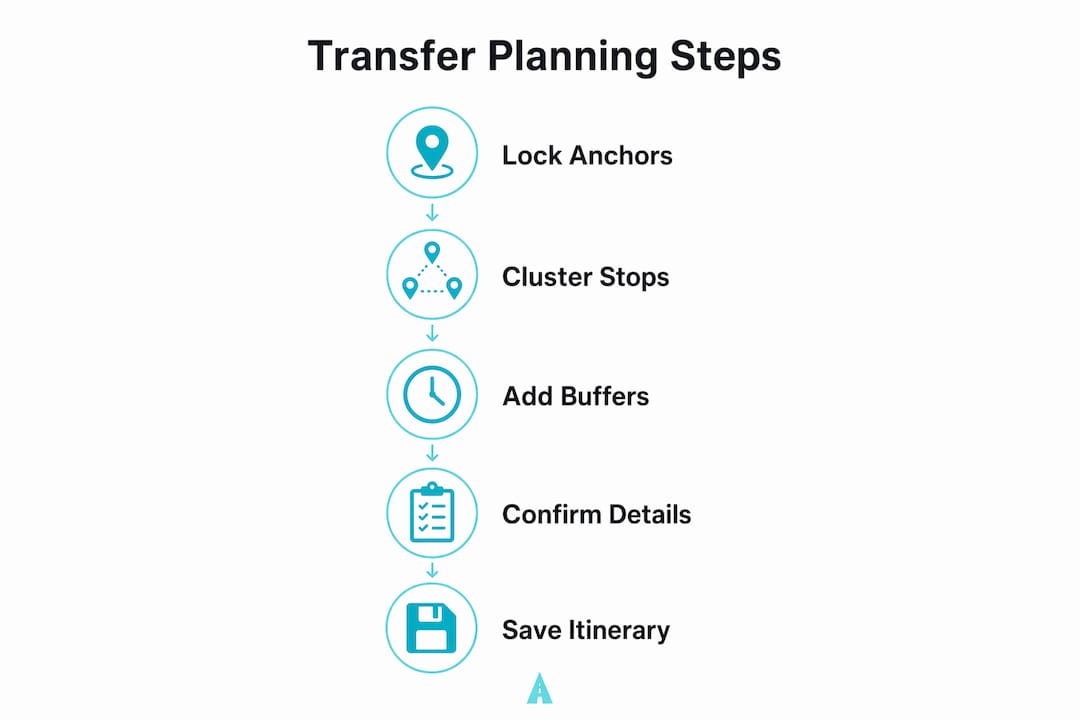
Anchor stops are the stops with the tightest time windows, such as a flight departure or a timed entry at Blue Lagoon. Lock those first. Build the rest of the itinerary around them. Book transfers at least 2–4 weeks in advance during peak season to secure the right vehicle and avoid last-minute price increases, especially for larger groups or remote Iceland destinations.

Pro Tip: Save your itinerary as a PDF on your phone before you leave home. Iceland's rural roads can have weak cell coverage, and an offline document keeps your plan accessible when you need it most.
How do you plan the order of stops to avoid backtracking?
Stop order is where most travelers lose money without realizing it. Backtracking silently inflates budgets because it causes repeated passes through the same travel corridor, adding distance and cost to every leg of the trip.
The right approach is geographic cluster planning. Group stops that are physically close to each other and complete them in one sweep before moving to the next cluster. For Iceland, a common example is combining Keflavík Airport arrivals with a Blue Lagoon stop before heading into Reykjavík. That route flows naturally southwest to northeast. Reversing it means doubling back along the Reykjanes Peninsula, which adds time and cost for no reason.
Follow this sequence to build a logical stop order:
- Identify your anchor stops. These are fixed-time commitments: flight arrivals, timed spa entries, or hotel check-in deadlines. They cannot move, so plan everything else around them.
- Map all remaining stops geographically. Use Google Maps or RouteXL to visualize where each stop sits relative to the others.
- Cluster stops by location. Group stops that share a geographic zone and complete each cluster before moving on.
- Run a route optimization check. Tools like RouteXL calculate the most efficient sequence automatically. Compare its suggestion against your anchor stop constraints.
- Confirm the final sequence with your provider. A driver familiar with Iceland's roads may flag road conditions or seasonal closures that affect the optimal route.
Building itineraries from geography-based clusters saves time, reduces costs, and simplifies logistics. This is the single most effective structural decision you can make when coordinating multiple transfer stops.
Pro Tip: Prioritize recovery time over speed when choosing between two route options. A route that takes 15 minutes longer but avoids a congestion-prone stretch near Reykjavík will almost always perform better in practice.
How do you communicate with your transfer provider effectively?
Clear written communication with your provider is not optional. Premium providers calculate extra costs for waiting time or added distance after the ride starts if stops were not clearly communicated upfront. Avoid that situation entirely by sharing a complete written itinerary before you confirm the booking.
Your written itinerary should include:
- Full addresses for every stop, not just city or landmark names
- Exact pickup and drop-off times for each leg
- Passenger contact numbers at each location
- Special requests such as extra luggage, child seats, or accessibility accommodations
- Contingency instructions for common scenarios like a delayed flight or a late hotel checkout
Verify exact terminals and pickup points rather than just city names. At Keflavík Airport, for example, the international arrivals hall and the domestic terminal are separate points. A driver waiting at the wrong one creates a missed connection even when everyone is on time.
Booking the entire itinerary with one provider reduces communication overhead and eliminates the risk of fragmented schedules. When one driver handles all stops, there is no handoff gap where a missed message causes a delay. For group travel across Iceland, this single-provider approach is the most reliable way to coordinate multiple transfer stops. You can read more about managing complex group logistics in this airport pickup coordination guide.
What pricing factors and timing buffers should you plan for?
Pricing for multi-stop transfers in Iceland depends on three main variables: total distance traveled, waiting time at each stop, and the number of segments in the itinerary. Communicating all stop details clearly before booking freezes your costs and prevents add-ons after the trip ends. Providers who offer fixed pricing, like Easytransfer, remove the guesswork entirely.
Timing buffers protect your itinerary when real-world conditions do not go as planned. Iceland's weather changes fast. A clear morning on the Reykjanes Peninsula can turn into a low-visibility wind event by afternoon. Traffic near Reykjavík during summer peaks is also a real factor.
| Transfer type | Recommended buffer | Why it matters |
|---|---|---|
| Airport to city hotel | 45–60 minutes | Accounts for baggage claim and traffic |
| Intercity legs (e.g., Reykjavík to Akureyri) | 60–90 minutes | Weather and road conditions vary significantly |
| Attraction stops (Blue Lagoon, Sky Lagoon) | 30–45 minutes | Timed entries and check-in queues add time |
| Domestic terminal connections | 60 minutes minimum | Terminal navigation and security add real time |
Buffer times of 45–90 minutes between critical transfer legs accommodate traffic delays, security checks, and terminal changes. Smaller urban stops may allow shorter buffers, but intercity and weather-sensitive transfers in Iceland require the longer end of that range.
"Buffer times are not just for comfort. They are critical travel insurance against real-world uncertainties like traffic and boarding delays." — Multi-Stop Bus Trip Planning Guide
Fastest routes rarely deliver reliability. A route that shaves 10 minutes off the schedule but leaves no buffer for a delayed flight creates a cascading problem across every stop that follows. Build resilience into your schedule first, then look at speed.
Key Takeaways
Arranging multi-stop transfers in Iceland requires locking anchor stops first, clustering remaining stops geographically, and sharing a complete written itinerary with a single trusted provider before booking.
| Point | Details |
|---|---|
| Lock anchor stops first | Identify fixed-time commitments and build the rest of the route around them. |
| Cluster stops geographically | Group nearby stops to eliminate backtracking and reduce total distance and cost. |
| Share a full written itinerary | Provide all addresses, times, and contacts to your provider before confirming the booking. |
| Use one provider for all stops | A single provider reduces communication gaps and prevents fragmented scheduling errors. |
| Build in 45–90 minute buffers | Iceland's weather and traffic make generous timing buffers a practical necessity, not a luxury. |
What I have learned from planning multi-stop transfers in Iceland
Most travelers make the same mistake: they book accommodation and attractions first, then try to fit transfers around those decisions. That approach forces inefficient routes because the geography was never considered during the booking phase. The correct sequence, as I have seen work consistently, is to fix your dates, map your stops geographically, identify your anchor constraints, and only then book the restrictive components.
The other mistake I see often is splitting bookings across multiple providers to save a small amount of money. In practice, fragmented bookings increase complexity and the risk of missed transfers because no single driver has full awareness of your schedule. When one leg runs late, there is no one responsible for adjusting the next. A single provider who knows your full itinerary can adapt in real time.
Iceland specifically rewards advance preparation. Roads that are straightforward in july can be impassable in november. A provider who covers the whole country and knows current conditions is worth more than the cheapest option you can find the week before you travel. Read the cancellation policy carefully before you book. A 24-hour full refund window gives you real flexibility if your plans change.
The travelers who have the smoothest multi-stop experiences are not the ones who planned the fastest routes. They are the ones who planned the most resilient ones.
— Sergiu
Plan your Iceland multi-stop transfers with Easytransfer
Easytransfer specializes in private transfers across Iceland with multi-stop options built into the booking process. One provider handles every stop on your itinerary, from Keflavík Airport to Blue Lagoon to Reykjavík city hotels, with no handoff gaps and no surprise fees. The fleet includes Mercedes vehicles and Tesla electric cars, with capacity for groups up to 49 passengers. Fixed pricing, flight tracking, and 24/7 support are standard on every booking.
Getting a quote is straightforward. Enter your preferred pickup and drop-off locations on the Easytransfer website, and a sales agent responds within 24 hours with a tailored plan for your route. Cancellations made more than 24 hours before departure receive a full refund. For travelers who want their Iceland logistics handled by one reliable team, Easytransfer covers the whole country.
FAQ
What is a multi-stop transfer?
A multi-stop transfer is a single booked journey that includes two or more pickup or drop-off points. It replaces multiple separate rides with one coordinated trip managed by a single provider.
How far in advance should I book multi-stop transfers in Iceland?
Book at least 2–4 weeks ahead during peak season. Last-minute bookings risk higher prices and limited vehicle availability, especially for larger groups or remote destinations.
How do I avoid surprise charges on multi-stop transfers?
Share a complete written itinerary with your provider before confirming the booking. Providers calculate extra costs for waiting time or added distance when stops are not communicated upfront.
What buffer time should I allow between stops in Iceland?
Allow 45–90 minutes between intercity transfer legs and at least 30–45 minutes at attraction stops like Blue Lagoon or Sky Lagoon. Iceland's weather and traffic conditions make generous buffers a practical necessity.
Is it better to use one provider or book each stop separately?
One provider is always the better choice for multi-stop itineraries. A single driver with full schedule awareness can adapt when delays occur, while fragmented bookings leave no one responsible for adjusting the overall plan.