

TL;DR:
- Iceland's naming law strictly regulates first names through the Mannanafnaskrá registry. Parents must choose approved names that meet linguistic and grammatical criteria and register within six months of birth. Recent reforms allow any approved name for any gender and introduce gender-neutral suffixes, reflecting social change while preserving linguistic standards.
Approved names in Iceland are defined by law, governed by the Personal Names Committee (Mannanafnanefnd), and documented in the official Mannanafnaskrá registry. Iceland's naming system is one of the strictest in the world. Names must conform to Icelandic linguistic rules, fit within an approved list, and be registered within six months of birth. The Mannanafnaskrá currently holds over 4,800 approved names, with 2,391 female names and 2,171 male names on record. That number reflects centuries of deliberate cultural preservation through legal means. Whether you are a new parent, a foreign resident, or simply curious about Icelandic naming law, understanding how this system works saves you time and prevents costly delays at birth registration.
What are the approved names in Iceland and how are they regulated?
Iceland's Icelandic naming law requires that every first name given to a child either appear on the Mannanafnaskrá or receive explicit approval from the Mannanafnanefnd. This is not a formality. Names that fail to meet linguistic or cultural standards are rejected outright. The system exists to protect the Icelandic language, which has fewer than 400,000 native speakers globally, making it one of the most carefully preserved languages in the world.
The Mannanafnaskrá functions as the official list of Icelandic approved names. Parents can search it online before choosing a name. If the name already appears on the list, registration is straightforward. If it does not, parents must submit a formal application and wait for a committee decision before the name can be used legally.
Iceland's naming culture is not about restriction for its own sake. The law reflects a national commitment to linguistic identity. Every approved name must work grammatically within the Icelandic language, which means it must decline across four grammatical cases. That requirement alone eliminates most foreign names in their original form.
What are the criteria for a name to be approved in Iceland?
A name gains approval in Iceland by meeting four core requirements set by the Mannanafnanefnd. These requirements cover alphabet use, grammatical function, pronunciation, and social impact. Meeting all four is non-negotiable.
The specific criteria are:
- Icelandic alphabet only. The name must use letters from the Icelandic alphabet. Letters C, Q, W, and Z do not exist in the Icelandic alphabet and are excluded from approved names. A name like "Wendy" or "Zachary" would fail this test immediately.
- Declinability in four cases. The name must decline in nominative, accusative, dative, and genitive forms. Icelandic grammar requires every noun, including a person's name, to change form depending on its role in a sentence.
- Spelling and pronunciation conformity. The name must follow Icelandic spelling conventions and be pronounceable by Icelandic speakers without ambiguity.
- No potential for embarrassment or ridicule. The committee rejects names that could expose a child to mockery or social harm.
One major shift came in 2019. Legal reforms removed gender restrictions for first names, meaning parents can now give their child any approved first name regardless of the child's gender. Before 2019, names were strictly categorized as male or female, and crossing that line was not permitted.
Pro Tip: If you love a foreign name, check whether a phonetically similar Icelandic name already exists on the Mannanafnaskrá. Choosing a close Icelandic equivalent is faster and avoids the formal application process entirely.
How does the Icelandic Naming Committee and registry system work?
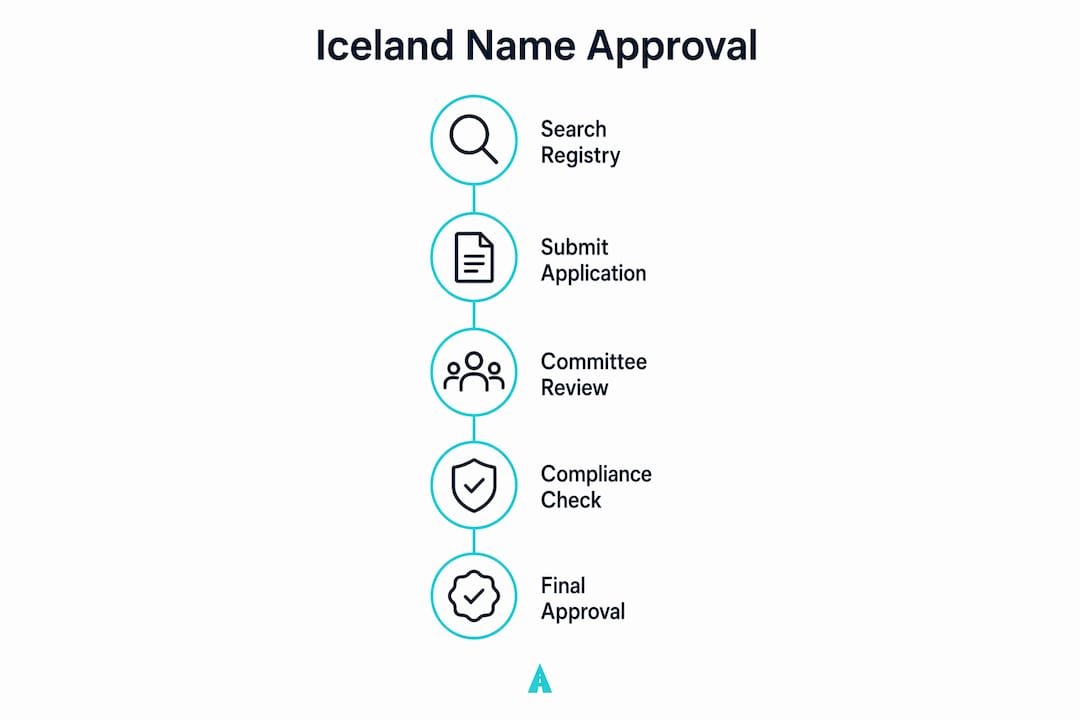
The Mannanafnanefnd is a formal government body with members appointed by Icelandic authorities. Its role is to review every name application that falls outside the existing Mannanafnaskrá. The committee ensures linguistic and cultural compliance for every name it evaluates. Members assess grammar, pronunciation, cultural fit, and social impact before issuing a decision.
The process works in two distinct tracks:
- Names already on the registry. If the name appears in the Mannanafnaskrá, parents register it directly through Registers Iceland (Þjóðskrá Íslands) without committee involvement. This is the faster path and takes days rather than weeks.
- New name applications. If the name is not on the list, parents submit a written application to the Mannanafnanefnd. The review period typically runs 4–12 weeks, and a fee applies. The committee may approve, reject, or request modifications.
- Appeals. If the committee rejects a name, parents can appeal the decision. Appeals follow a separate administrative process and extend the timeline further.
- Registry updates. Names approved through the committee process are added to the Mannanafnaskrá, making them available for future parents to use without reapplying.
The Mannanafnaskrá has existed for decades and reflects the historical depth of Icelandic naming culture. Names like Sigríður, Björn, and Guðrún appear on the list because they have been part of Icelandic society for centuries. The registry is not static. It grows as the committee approves new names, but growth is deliberate and slow by design.
What practical steps should parents follow to name a baby in Iceland?
Parents must officially name their child within six months of birth through religious christening or notification to Registers Iceland. Missing this deadline creates legal complications and can delay the child's identification documents. Starting the process early is the single most important thing you can do.
Follow these steps to navigate the process confidently:
- Search the Mannanafnaskrá first. The registry is available online. Check whether your preferred name already appears before assuming you need a committee application. Many parents skip this step and waste weeks unnecessarily.
- Submit a reasoned justification for new names. If your name is not on the list, applications succeed more often when they include a reasoned justification citing similar approved names as precedents. This is called a rökstuðningur in Icelandic. Reference comparable names already in the registry and explain how your proposed name meets the linguistic criteria.
- Apply well before the six-month deadline. The formal review takes 4–12 weeks, so submitting an application in the first month after birth gives you enough buffer to appeal if needed.
- Foreign parents have some flexibility. Foreign parents can pass on family surnames and may use names from their home country if those names comply with Icelandic orthographic and pronunciation rules. A name like "Sofia" works because it uses only Icelandic-compatible letters and declines naturally. "Charlotte" does not, because the letter C is excluded.
- Avoid names with excluded letters. Review your preferred name for C, Q, W, and Z before submitting anything. Catching this early prevents wasted application fees.
Pro Tip: Referencing Icelandic grammar rules directly in your application, and citing two or three comparable names already on the Mannanafnaskrá, significantly improves your odds of approval on the first submission.
You can find deeper context on Icelandic naming traditions to understand which name roots and patterns the committee tends to favor historically.
How have recent legal changes affected Icelandic baby naming?
The 2019 legal reforms represent the most significant shift in Icelandic naming conventions in decades. Before 2019, first names were strictly assigned by gender. A boy could not receive a traditionally female name, and vice versa. The 2019 reform removed those gender restrictions, allowing any approved first name to be given to any child regardless of gender.
The same reform introduced the suffix "bur" as a gender-neutral alternative to the traditional "son" (for sons) and "dóttir" (for daughters) used in Iceland's patronymic and matronymic naming system. A child whose parent is named Jón can now be Jónbur instead of Jónsson or Jónsdóttir. This change reflects a broader social shift toward inclusion while preserving the grammatical structure that defines Icelandic surnames.
The reforms did not loosen the linguistic criteria for name approval. The alphabet rules, declension requirements, and pronunciation standards remain fully in force. What changed is who can use which approved name, not what qualifies as an approved name. That distinction matters. Parents exploring gender-neutral naming still work within the same registry and the same committee process.
Culturally, these changes signal that Iceland treats its naming system as a living institution rather than a fixed historical artifact. The language is protected, but the social framework around it adapts. For families planning to visit Iceland or settle there, understanding this balance helps you approach the naming process with realistic expectations.
Key Takeaways
Iceland's naming system requires parents to choose from the Mannanafnaskrá or apply to the Mannanafnanefnd, meet strict linguistic criteria, and register a name within six months of birth.
| Point | Details |
|---|---|
| Six-month deadline | Register your child's name within six months of birth to avoid legal complications. |
| Registry check first | Search the Mannanafnaskrá online before applying; using an existing name skips the committee entirely. |
| Linguistic criteria are strict | Names must use only Icelandic alphabet letters and decline across four grammatical cases. |
| New names take 4–12 weeks | Apply early and include a reasoned justification citing comparable approved names. |
| 2019 reforms expanded flexibility | Gender restrictions on first names were removed, and the suffix "bur" was introduced for non-binary individuals. |
Why Iceland's naming laws deserve more respect than they get
People outside Iceland often hear about the naming rules and assume they are bureaucratic overreach. I disagree. Iceland has fewer than 400,000 speakers of a language that has remained remarkably stable for over a thousand years. That stability is not accidental. It is the result of deliberate, consistent effort at every level of society, including how children are named.
What strikes me most is how the system balances preservation with practicality. The committee does approve new names. The registry does grow. The 2019 reforms show that the system can adapt to social change without abandoning its linguistic foundation. That is harder to achieve than it looks.
My advice for foreign parents is this: treat the Icelandic naming rules as a cultural invitation rather than an obstacle. Research the Mannanafnaskrá early, find a name that genuinely fits the linguistic framework, and submit a thorough application if you need committee review. The process rewards preparation. Parents who arrive at the six-month deadline without a registered name face real stress. Parents who start in the first weeks after birth have time to navigate every step calmly.
The naming system is one of the most honest expressions of what Iceland values. Respecting it is not just legally required. It is the right way to start a child's life in this country.
— Sergiu
Traveling to Iceland with family? Easytransfer has you covered
Families relocating to Iceland or visiting for the first time often underestimate how much logistics matter once you land. Getting from Keflavík Airport to Reykjavík with children, luggage, and a plan already in motion requires a transfer service you can count on.
Easytransfer provides private transfers across Iceland with fixed pricing, flight tracking, and vehicles that accommodate families and groups of up to 49 passengers. The fleet includes Mercedes models and Tesla electric vehicles, all with free WiFi onboard. Booking is instant, cancellation is free up to 24 hours before pickup, and a sales agent responds to custom route requests within 24 hours. Whether you need airport and destination transfers to the Blue Lagoon, Sky Lagoon, or anywhere else in Iceland, Easytransfer handles the details so you can focus on what matters.
FAQ
What is the Mannanafnaskrá?
The Mannanafnaskrá is Iceland's official registry of approved baby names, currently containing over 4,800 names. Parents can use any name on this list without applying to the Personal Names Committee.
How long does name approval take in Iceland?
Names not on the official registry require a committee review that typically takes 4–12 weeks. Parents should apply as early as possible to stay within the six-month legal naming deadline.
Can foreign parents use non-Icelandic names?
Foreign parents have some flexibility, but names must still comply with Icelandic alphabet and pronunciation rules. Names containing the letters C, Q, W, or Z are not permitted.
What changed with Iceland's 2019 naming law reform?
The 2019 reform removed gender restrictions on first names and introduced the gender-neutral suffix "bur" as an alternative to "son" and "dóttir" in Iceland's patronymic naming system.
What happens if you miss the six-month naming deadline?
Missing the deadline creates legal complications and can delay a child's identification documents. Iceland law requires official name registration within six months of birth through Registers Iceland or religious christening.