

TL;DR:
- Effective airport pickup coordination involves establishing specific meeting points, assigning clear communication roles, and utilizing real-time flight tracking tools. Adhering to airport rules, such as using designated waiting lots and approved meeting locations, prevents delays and confusion during arrivals. Proper planning with detailed flight information, time buffers, and technology ensures smooth, efficient group or individual pickups.
Airport pickup coordination is the process of organizing meeting points, timing, and communication to connect arriving travelers with their transportation without delays or confusion. Whether you are picking up a single guest from Keflavík Airport or managing a 30-person tour group at a major international hub, the same core principles apply: know the airport rules, assign clear roles, and use the right tools. This airport pickup coordination guide covers everything from curbside restrictions to group messaging templates, so you can handle arrivals with confidence and zero last-minute scrambling.
What rules and facilities affect airport pickup coordination?
Airport curbside restrictions are the single biggest factor that shapes how pickups must be coordinated. At San Francisco International Airport (SFO), for example, curbside waiting is prohibited. Vehicles cannot park unattended at curbs or roads, and fines apply for violations. The passenger must be standing outside before the vehicle even arrives. This rule is common at major airports worldwide, and ignoring it creates chaos for everyone involved.
The practical solution is the cell phone waiting lot. SFO offers a free waiting lot where drivers can wait up to 60 minutes while staying in their vehicle. The lot is located close to the terminals and is open from 5:00 a.m. to 1:00 a.m. daily. Drivers stage there until the passenger confirms they are outside and ready, then pull directly to the curb for a fast, compliant pickup.
Official meeting points inside terminals solve the other half of the problem. SFO designates specific signed meeting points near gates and baggage claims for Terminals 1, 3, and the International Terminal. These fixed locations eliminate the vague "meet me outside" instruction that causes passengers to wander and drivers to circle.
Here is what you need to know about airport facility rules before coordinating any pickup:
- Curbside zones are for active loading only. No waiting, no parking, no exceptions at most major airports.
- Cell phone waiting lots are free, attended, and the correct place for drivers to stage until passengers are ready.
- Terminal meeting points are signed locations near baggage claim or exits, designed specifically for pickups.
- Security perimeters prevent non-ticketed individuals from entering gate areas, so all meeting points must be post-security or at arrivals.
- Airport enforcement is active. Officers will ask vehicles to move within minutes at busy curbs.
Pro Tip: Before any pickup, look up the specific airport's ground transportation page. Every major airport publishes its curbside rules, waiting lot locations, and official meeting points. Spending five minutes on this research prevents 30 minutes of confusion on arrival day.
How to plan and communicate airport pickups for small and large groups?
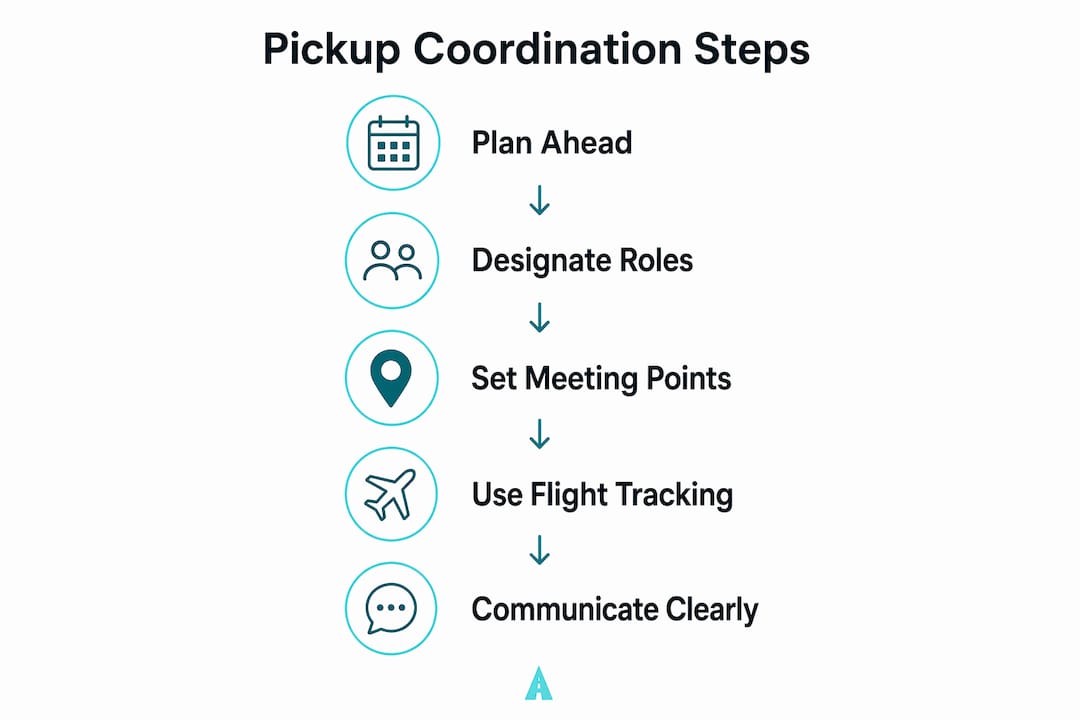
Effective group airport pickup planning starts with collecting the right information before anyone boards a plane. The coordination model that works at airports with strict curb policies uses a single designated meeting point inside or just outside the terminal, combined with a cell phone waiting lot for the vehicle to stage until passengers are ready. This eliminates guesswork and repeated circling, and it scales from two people to 40.
Follow these steps to build a solid pickup plan:
- Collect all flight details. Gather flight numbers, arrival times, and airlines for every traveler. Note any special requirements such as wheelchair assistance, oversized luggage, or traveling with children.
- Assign a primary coordinator and a backup. Sharing both contacts with the transportation provider prevents delays when one person is unreachable. The coordinator is the single point of contact for the driver and all group members.
- Set a realistic "be ready by" time. Schedule pickup times with generous buffers to accommodate baggage claim delays, restroom breaks, and heavy airport traffic. A 30 to 45 minute buffer after the scheduled landing time is a reasonable baseline for international arrivals.
- Choose a specific meeting point. Pick one named, signed location inside the terminal. "Near the baggage carousel for Flight 204" is better than "outside the airport." A named meeting point near baggage claim is better still.
- Send a group message template. A clear group message with the pickup time, exact meeting spot, "be ready by" time, and instructions for delays reduces ad-hoc confusion and keeps everyone on the same page.
- Decide: inside terminal or curbside? Meeting inside the terminal is calmer and easier for passengers with heavy bags, but requires the driver to park or use a waiting lot. Curbside is faster when passengers are ready on arrival, but only works if the airport permits brief stops and the timing is precise.
Pro Tip: For groups of eight or more, create a shared document or group chat before the trip. Include the meeting point photo, coordinator phone numbers, and the exact message to send if someone misses the group. Distribute it 24 hours before departure so everyone has it saved offline.
What tools and technology improve airport pickup coordination?

Technology turns a reactive pickup into a proactive one. Flight tracking tools integrated with messaging apps allow coordinators and drivers to receive real-time updates, adjusting pickup timing dynamically for early or delayed arrivals. Without tracking, a driver who arrives on schedule for a flight that landed 40 minutes early will find an empty curb and a frustrated passenger.
The most useful tools fall into four categories:
- Flight tracking apps: FlightAware, FlightRadar24, and Google Flights all provide real-time status updates including gate changes and baggage carousel assignments. FlightAware sends push notifications for status changes, which is particularly useful for coordinators managing multiple flights.
- Group messaging platforms: WhatsApp, Telegram, and Signal support group chats with location sharing. WhatsApp's "live location" feature lets a coordinator share their real-time position with the entire group, removing any ambiguity about where to meet.
- Shared calendars: Google Calendar and Apple Calendar allow coordinators to send flight arrival events with meeting point details to every group member. Everyone sees the same information without relying on a single forwarded message.
- Transport booking platforms: Professional transfer services like Easytransfer build flight monitoring directly into their booking system, so the driver is automatically notified of delays without the coordinator needing to make a separate call.
| Tool | Best use case | Key feature |
|---|---|---|
| FlightAware | Tracking individual flights | Push alerts for gate and status changes |
| Group communication | Live location sharing and group chat | |
| Google Calendar | Sharing arrival schedules | Event invites with meeting point details |
| Easytransfer booking system | Professional transfers | Integrated flight monitoring and driver alerts |
The combination of a flight tracker and a group messaging platform covers 90% of coordination needs for most travelers. For travel agents managing multiple groups simultaneously, a transport booking platform with built-in monitoring is the more reliable choice.
What are common challenges in airport pickup coordination?
Flight delays are the most predictable challenge, and they are best handled before they happen. Build a contingency rule into your group message: "If your flight is delayed by more than 60 minutes, text the coordinator immediately." This single instruction prevents the scenario where a driver waits at the curb while a passenger sits at a connecting gate with no way to communicate.
Here are the most common problems and how to handle each one:
- Flight delays and early arrivals: Use a flight tracking app to monitor status in real time. The driver stages in the waiting lot until the coordinator confirms the passenger has cleared baggage claim.
- Confusion over meeting points: Send a photo of the exact meeting point location in the group chat before the trip. A picture of the sign or the baggage carousel number removes all ambiguity.
- Dead phone batteries or lost signal: Designate a backup coordinator who holds a portable charger. Ask all group members to download the airport map offline before traveling.
- Multiple flights arriving at different times: Stagger pickups by 30 to 45 minutes per flight, or use a vehicle large enough to wait for the last arrival. For large group arrivals, a single large vehicle waiting for all passengers is often more cost-effective than multiple smaller trips.
- Airport enforcement at curbside: Never ask the driver to wait at the curb. Use the cell phone waiting lot and only call the driver when the passenger is physically standing at the exit.
"Pre-agreed specific meeting points combined with a nearby external waiting area optimize pickup success at airports with strict curb rules. This coordination model reduces wasted time and confusion during the critical handoff moment." — SFO Ground Transportation Guidelines
Managing staggered arrivals is where most group coordinators struggle. The fix is a simple spreadsheet: list each flight, its scheduled arrival, the estimated baggage claim time, and the "call the driver" time. Share it with the driver and the backup coordinator. When one flight runs late, everyone sees the updated picture without a single phone call.
Key takeaways
Effective airport pickup coordination requires clear meeting points, designated communication roles, and knowledge of airport-specific rules before arrival day.
| Point | Details |
|---|---|
| Know curbside rules | Most major airports prohibit unattended curbside waiting; use cell phone lots instead. |
| Use specific meeting points | Named, signed terminal locations reduce passenger confusion far better than vague instructions. |
| Assign a coordinator and backup | Share both contacts with the driver to prevent delays when one person is unreachable. |
| Build in time buffers | Schedule "be ready by" times 30 to 45 minutes after landing to absorb baggage and traffic delays. |
| Track flights in real time | Apps like FlightAware let coordinators adjust pickup timing before delays become problems. |
What I have learned from coordinating airport pickups
After years of working with travelers and transfer providers across Iceland and beyond, the single biggest mistake I see is treating airport pickup as something to figure out on the day. Groups of 10 or more arrive at Keflavík Airport, and within minutes there are three separate WhatsApp threads, two people waiting at different exits, and a driver circling the terminal because no one confirmed a meeting point in advance.
The fix is not complicated. Treat the pickup as a small project with a defined owner, a written plan, and a communication channel that everyone has joined before they board the plane. One coordinator. One meeting point. One message thread. That structure alone eliminates 80% of the confusion I have seen.
The other thing I would push back on is the instinct to meet curbside because it feels faster. At airports with strict no-wait policies, curbside coordination is actually slower. The driver gets waved off, circles again, and the passenger stands in the cold waiting. The waiting lot plus a confirmed meeting point inside the terminal is consistently faster in practice, even though it feels like an extra step on paper.
For travel agents coordinating multiple groups, the step-by-step transfer guide from Easytransfer is worth bookmarking. It covers the logistics of managing large arrivals in a way that translates directly to any airport, not just Keflavík.
— Sergiu
Let Easytransfer handle your airport pickup coordination

Easytransfer specializes in private airport transfers across Iceland, with built-in flight monitoring so your driver always knows when your flight lands. Whether you are a solo traveler arriving at Keflavík Airport or a travel agent coordinating a group of 49 passengers, Easytransfer handles the timing, the waiting, and the communication so you do not have to. Every booking includes fixed pricing, door-to-door service, and 24/7 support. Explore private transfer options and get a quote for your group. A sales agent will respond within 24 hours with a tailored plan for your arrival.
FAQ
What is airport pickup coordination?
Airport pickup coordination is the process of organizing meeting points, timing, and communication between arriving travelers and their transportation. It includes selecting a specific meeting location, tracking flight status, and assigning a coordinator to manage communication.
How do I coordinate airport pickups for a large group?
Assign one primary coordinator and one backup, collect all flight details in advance, and send a group message with the exact meeting point and "be ready by" time. For groups of eight or more, a group airport transportation guide with staggered pickup schedules prevents bottlenecks.
Can drivers wait at the airport curb during pickup?
At most major airports, including SFO, curbside waiting is prohibited and fines apply. Drivers should use the designated cell phone waiting lot and only pull to the curb once the passenger confirms they are standing at the exit.
What is the best app for tracking flights during airport pickups?
FlightAware and FlightRadar24 are the most reliable options for real-time flight status, gate changes, and delay alerts. Google Flights also provides status updates and is useful for coordinators managing multiple arrivals from a single interface.
How much buffer time should I add to an airport pickup schedule?
Add 30 to 45 minutes after the scheduled landing time for international arrivals to account for immigration, baggage claim, and customs. For domestic arrivals with carry-on luggage only, a 15 to 20 minute buffer is typically sufficient.